Orientalists and Oil

orientalisme (1838; de oriental) 1. Science, goût des choses de l’Orient 2. Caractère oriental

-Dictionnaire Petit Robert

“Partly due to the reassessment of the last century- the ridiculous has again become the sublime- as well as to a renewed esteem for technique, Orientalism has again come back into favour.”

- The Orientalists: Painter-Travellers, by Lynne Thornton

The science and taste- as the French would say- for things of the Orient. I’ll test a bite of that. When I was young my grandfather repeatedly screened a 16mm print of Ali Baba and the Forty Thieves featuring, as the trailer would have it, the “tantalizing beauty of Maria Montez”- real name, Maria Africa Gracia Vidal, a Dominican actress known as the Queen of Technicolor for her acclaim in heavily colorized action adventure movies.

Maybe that was what hooked me, as the trailer went on to scream in scrolling block print, on “the splendor and spectacle of the Exotic East” and “the fiery adventure of Daring Rogues.” When the end credits bled out to black, I was left in the dark with my imagination. But then I came upon the pictures…of French paintings from the same exotic East, with the same daring rogues and tantalizing beauties.

Ingres, Gérôme, Delacroix, and others perhaps you’ve never heard of- Chassériau, Decamps, Vernet, and Benjamin-Constant (whose painting The Serbian Concubine depicting not one but two nudes in the war-helmeted and armoured sultan’s bed is not on view for obvious reasons, but said to be “emblematic of his production” as reads the accession note)- unless you visit the Orientalist painting gallery (named for Kenneth Jay Lane, a designer of costume- dit fake- jewelry) at the Metropolitan Museum located just outside the Islamic wing so you can easily pivot from the real to the make believe.

Edward Said put Gérôme’s painting The Snake Charmer on the cover of his critique of Orientalism, as if to illustrate the wrong headedness of the entire genre- here in a mosque is a naked boy wearing a snake like a sousaphone before a panel of Islamic calligraphy whose spelling and orthography is as ridiculous as you might imagine a non-Arabic speaking non-Muslim can make it, as far from the sublime as one can take it.

Benjamin-Constant’s The Serbian Concubine, off view at the Metropolitan Museum

Benjamin-Constant’s The Serbian Concubine, off view at the Metropolitan Museum

Friday at the Cairo Bath house

“I was three days ago at one of the finest in the town and had the opportunity of seeing a Turkish bride received there. All the she-friends, relations, and acquaintances of the two families meet at the bagnio, several others go out of curiosity, and I believe there were that day two hundred women…the virgins very hastily threw off their clothes and appeared without other ornament or covering than their own long hair braided with pearl or ribbon…

She was a beautiful maid of about seventeen very richly dressed and shining with jewels but was presently reduced to the state of nature. Two others filled silver pots with perfumes and began the procession…In this order they marched round the three large rooms of the bagnio. ‘Tis not easy to represent to you the beauty of this sight, most of them being well proportioned and white-skinned; all of them perfectly smooth and polished by the frequent use of bathing.”

-Turkish Letter XLII, 1718, Lady Mary Wortley Montague to the Countess of —

Opposite is the Hamman of Sultan Inal [Bayn al-Qasrayn Quarter], now called the Hammam al-Sultan, all that remains of a large palace built in 1456 and still in use as a public bath. The superstructure is modern but the interior is of interest with a great domed steam room and marble reclining slabs.

-Blue Guide to Egypt, Itinerary 5, Bab al-Futuh to Maydan al-Azhar

Jean-Leon Gérôme and all the other late 19th C. orientalist painters who imagined the inside of the ladies’ bath must have read Lady Mary’s letter from a Constantinople bagnio written some 150 years earlier. Threw off their clothes…hair braided with pearl and ribbon…shining with jewels but reduced to a state of nature…well proportioned…white skinned and perfectly smooth and polished- it absolutely makes the mind race.

My experience was a bit different. It was men’s night, Thursday, and a few fellow students decided to try out an old hammam in the even older Fatimid city. It was Alan’s idea but we all went along. Was it in the quarter of Gamaliyya, Batiniyya, Darb al-Ahmar, or Bayn al-Qasrayn? I can’t remember. It well may have been the 15th C. Hammam of Sultan Inal.

We were about four in number and entered the hammam to find a dingy cold central reception room with a dingy cold floor. We were shown to our changing alcove, open to the main area but for a half-size swinging double door, with a bench, a stack of towels, and wooden shower clogs. We each wrapped one towel around our waist and draped another over our shoulders and headed to the steam room. The temperature was barely tepid in what the Romans would have called the caldarium. I shudder to think what it was like in the tepidarium.

There were a few other men in there, all dimly lit, some I presume cleaning themselves extra well for the next day’s prayer, maybe a few because they had no water at home of any sort. Around the heated pool at center, which no one was in because to me it looked green and dark, were side niches with stools and faucets out of which came cold water. We sat around and waited for it to get warmer.

Then Alan decided to try the pool so he threw off the towels and slid in. It was very hot, he said, in fact almost too hot. And then he froze, went rigid, and started trembling. It was the second time I’d seen him do this, have an epileptic seizure. The first time I was walking beside him along the Nile corniche with traffic speeding by. I caught him then before he fell to the ground and cradled him. He went to sleep in my arms and after some minutes opened his eyes and looked very calm and got up and we walked slowly back.

This time Alan was half submerged in green water. We pulled him out, laid him down on our towels, so we were all fully naked by then. Someone cupped his head in their hands so he would not bang it on the marble floor. The temperature seemed to be heating up, but maybe it was from our insides, not the outside. When he opened his eyes, we asked if he wanted to get out of there, go back to the changing room, and he said yes, so we each grabbed a limb and carried him out of the steam room, laid him on the alcove’s bench, and covered him with towels. Tea is always served after a bath, so we sat around, still mostly naked, sipping our tea and waiting for Alan to feel better. When he did, we got dressed and walked slowly back to our dorm.

I remember the Fatimid city, usually Cairo’s busiest, noisiest part, as being very dark and quiet that night. It was after midnight, but very eerie for more reason than that.

Great Bath at Bursa, Jean-Leon Gérôme 1885

Great Bath at Bursa, Jean-Leon Gérôme 1885

Arabists- A Strange, Odd, etc. Western Peculiarity

mustaghrib (pl. mustaghribeen in Egyptian Arabic) Europeanized, Westernized

mustaghrab (pl. mustaghrabeen) strange, odd, queer, quaint, unusual, extraordinary, curious, peculiar

- A Dictionary of Written Modern Arabic, Hans Wehr

“…an Arabist, one of the most loaded words in America’s political vocabulary. In the late nineteenth and twentieth centuries an Arabist was merely a student of Arabic, like a Hellenist or a Latinist. But with the birth of Israel…the word ‘became a pejorative for he who intellectually sleeps with Arabs’, someone, that is, assumed to be politically naive, elitist, and too deferential to exotic cultures. The word almost presumes guilt.”

-Arabists;The Romance of an American Elite by Robert Kaplan

Dhahaba al-arabu bahthan ‘an maa’in” “The Arabs departed, searching for water”

There were two notable student types frequenting the garden at the American University in Cairo in 1979, the year that Egypt made peace with Israel- mustaghribeen Francophone co-eds and mustaghrabeen American students of Arabic. If anyone had called us Arabists in those days, we would have asked in what century they were living or maybe punched them in the nose.

Each sat on opposite sides of the snack bar and barely mixed- the Americans, aptly, around a marble Mamluk-style fountain outside Oriental Hall and the Egyptians, aptly also, beside the campus’ clay courts that could have been at the French Open.

The co-eds wore skin tight jeans and strappy high heels with coifs and maquillage to the max. I remember that we Americans just wore jeans and had no time to comb our hair. Arabic study is not easy and often gets in the way of one’s looks. We were a mixed group of graduate students planning careers that required Arabic fluency, and dhahaba al-arabu bahthan ‘an maa’in- a typical sentence in the first year Arabic primer, correctly declined, conjugated, and inflected- does not translate itself without a lot of hard work.

Kathy become an Arabic bibliographer for top libraries and then entered the foreign service. Sharon became an anthropologist specializing in the Nuer. Paula became a medieval historian, eventually publishing a scholarly article on the Islamic law question, Where in a mosque do hermaphrodites pray?- a topic that she first presented in our colloquial Arabic class that had us all pouring through dictionaries- and Laurie became a political scientist.

Even later once they had greatly improved their Arabic, none would have called themselves Arabists or even Arabistes. And I doubt that the co-eds would have called themselves mustaghribeen ever, because for them to say Merci Awi, a code-switching Egyptian’s way to accept their drink from a sufragi with a “Thank you very much”, is a verbal act of neither east nor west- it just sounds right when sitting in the AUC garden at tea time and you can’t decide where you are or who you want to be

Where budding Arabists would sit, “searching for water”

Where budding Arabists would sit, “searching for water”

Letter from Estela

3-XI-95

Querido Luis, Espero que cuando recibas estas lineas te encuentres bien…bueno Luis, yo quisiero que tu como fuera de esta pais me dieras tu punto de vista en cuanto a la situacion que vive en este momento como veras si los ricos se quejan como estan todos los umildes. Pero lo que si te digo Luis que quiero tu opinion de lo que…Feliz navidad y que el cielo te calme de benediciones…

- Estela Lopez Toriz

Estela was one of the four individuals in the ejido Dario Martinez (Valle de Chalco, State of Mexico, on the highway to Puebla just outside the DF boundary past Ciudad Neza) I interviewed over a 2 year period from 1989-1990 for a community oral history I gathered and translated for the Inter-American Foundation (see entries for January 23 for the full report). We stayed in touch by mail for a few years after my last visit during which I gave her a copy of her testimonials that I had edited and transcribed.

It was not easy for her to write to me- her community had no post office, no mail delivery or other government services. I am certain that few of my letters reached her (in fact her letter lamented that she had not gotten any replies to her previous letters sent to me, which either I had not received, or perhaps my returns had not arrived to her).

I recently found this letter from her, written in November 1995, asking my opinion on some updated political news from Dario Martinez- a not unusual tussle between rival community action groups- and wishing me a Merry Christmas, that was folded into a book on my shelf. I don’t remember why I put it there or when.

I had forgotten the letter, but not Estela. She was a single mother, a fighter and a scrapper, a community organizer and an advocate for her neighbors, trying to get the essential services- electricity lines, drainage and sewerage, clean water, a decent primary school- that they deserved for their neighborhood.

Proper mail service was the least of these. The fact that she sent me letters at all, that she thought it a normal thing to write from her squatter settlement to an American in New York, that she expected the mail to arrive despite everything in Mexico that would make such a thing doubtful, proves more importantly that she expected to have the same things that other Mexicans count on without a second thought- a way to speak out, a way to be heard, and a way to be answered.

Feeding Papa Alberto's Pajaritos

Round-Tailed Manakin. Pipra chloromeros. Locally fairly common in Andean foothills and in Amazonia, up to 1500m. While sympathetic with Red-headed Manakin, Round-tailed is more prevalent in seasonally flooded forest; otherwise will occupy terra firme. Short tail in both sexes is slightly graduated. Male often appears crested on nape, but dark eyed individuals safely distinguishable only by tail shape. Voice Song bouts include variable high metallic sounds, mellow whistles, squeaky chatters, and buzzes; a characteristic sound is a buzzy “tsuk’ZRRRT” or ”tsik’DZZRT” and a high rising-falling laugh.

-Birds of Peru, Princeton Field Guide

“Nevertheless this extremely important work is not the end of exploration and investigation on the birds of Peru, because there still exist many unexplored and unknown areas in a country that is complex and full of surprises.”

-from the forward by Dr. Antonio Brack Egg

Papa Alberto was a grandfather who lived next door to Tomas, his married daughter Emma, and their eight year old son Fredy Paul. Alberto lived with his wife Maria and unmarried daughter Elvira. Retired and stooped after a career working in the town brewery, every morning he shuffled up the outside stairs to the second floor roof terrace where he fed his canaries, four cages of them always alive with song. The houses’ two back courtyards were separated by a five and a half foot wall, high enough to maintain privacy between low statured Andeans but permitting a wide open view to taller gringos.

I would greet the bald and dark-eyed Alberto when I saw him on the terrace cleaning cages and adding seed to the feeders. He would greet me back with a happy wave and a mellow whistle, not a “tsuk’ZRRRT” or a “tsik’DZZRT”. He had work to do. Arequipa’s snow-capped volcano El Misti was always in the background, our neighborhood Cerro Colorado was up on its falda. That was a good summer, learning the augmentative and diminutive forms of new words like pedón and pajarito.

Pedón I learned from Fredy and pajarito from Alberto. I thought both were funny words. Later I learned that a pipra was called a saltarín in Spanish, a jumper. Alberto’s canaries did not jump, they did not laugh, and as far as I know they did not pass gas. Alberto would never have said even if they did.

A Round Tailed Manakin, not one of Papa Alberto’s pajaritos

A Round Tailed Manakin, not one of Papa Alberto’s pajaritos

To Dakhla, For the Waters

Renault: And what in heaven's name brought you to Casablanca?

Rick: My health. I came to Casablanca for the waters.

Renault: The waters? What waters? We're in the desert.

Rick: I was misinformed.

1979. Egypt’s Western Desert. Waha Dakhla. The Inner Oasis. According to Herodotus, an Island of the Blest. I had been invited by a student I’d met in a Cairo coffeehouse who was from Dakhla’s ‘Izbet Gharghour, the Hamlet of Gharghour, a tongue-twister of a name for a non-Arabic speaker because it has two of the most difficult to pronounce consonants in the alphabet, the letter ‘ayn, an unvoiced guttural stop, and the ghayn, a voiced velar fricative.

Saying it right was almost as difficult as getting there, by train to Asyut from Cairo, by bus from Asyut to Dakhla’s market town of Mut, via Kharga Oasis, and from Mut to Gharghour by donkey cart.

I arrived at the door of the student’s house. His father welcomed me and showed me in. I met his brothers, male cousins, uncles, and so many others. And so many questions for a guest who had come from so far away.

Several days passed in the majlis, the men’s room, talking, taking tea, eating dates and oranges from the trees out his window. One night we piled into a pick up truck to go into the desert a few miles to Deir al-Hajar, House of Stone, a Roman era temple built in the Egyptian manner, with dedications to Titus, Vespasian, Domitian, and Nero.

Just outside the enclosure wall was a water tank filled from a hot spring. We jumped in, under the stars. It was almost boiling, so it seemed. The air was very cold. We were in the desert. Cold air. Hot water. I was misinformed. Ghalat. Error. Spelled with a ghayn.

Seeking the Waters at Deir al Hajar in Dakhla Oasis,

Seeking the Waters at Deir al Hajar in Dakhla Oasis,

A Tifoultoute Night

Bentley: What is it, Major Lawrence, that attracts you personally to the desert?

Lawrence: It's clean.

Bentley: Well, now, that's a very illuminating answer.

March 2003. On the Route of the Kasbahs, from Telouet to Ait Benhaddou, from Taourirt to Ait Ben Moro. From New York I thought I had made a reservation for the night at an out-of-the-way kasbah I’d found in the book, where the cast of Lawrence of Arabia had been billeted during the Morocco scenes shot in 1961. Tifoultoute. I had called the telephone number listed in my old guide, an aged voice had answered and I thought we had agreed on a room for four, two adults and two children, and a date. Was my French so bad? Was his?

We arrived late at the Kasbah’s half closed outer gate which I pushed and drove through. The main door was open but the reception area looked a mess. Unswept. No answer. Finally an elderly woman came, I said we had arrived. She said welcome, I said we’d like tea on the terrace, below the spire where the storks had built their nest, she said waha. We climbed stairs that had not been cleaned in years and watched the stork parents make strange stork noises towards their unseen young in the nest as the sun set.

I got up to find the lady and said we’d like to see our rooms. She looked worried. I said I’d made a reservation from America. She looked more worried. She showed us to one of the second floor rooms along the inner courtyard overlooking the reception. It had multiple beds, all unmade. I asked for sheets. She gave us rough Berber blankets. I asked when and where we could have dinner. The children were hungry. She looked worried again and said to wait in the room, she would call us.

From our window overlooking the outer courtyard I saw a bus unloading tourists who entered the reception room below which had been quickly set with low tables and stools. Food trays were also unloaded from the bus. A music group and line of dancers were waiting there.

I went downstairs to find our table. There was nothing for us. Wait, I was told. The floor show began, a spirited ahidous, the kind Paul Bowles had driven down from Tangier to see and record, in which he almost fainted because of the heat and claustrophobic press of spectators, a night he said “of fire and drums”. We watched from the railing above. I went down again to ask for dinner. A tray was brought up, one large bowl with boiled egg and rice, four spoons, and a pitcher of water. One glass. The music and dance ended, the tourists left, we ate in the room and slept. In the morning I looked for the lady, no one was there. We walked down the stairs and called again. Nothing. We left.

The desert was clean, of yellow sand. Kasbah Tifoultoute was less clean, of mud brick. Now I hear it is completely renovated. And cleaner.

ouarzazate.jpg

Khodja and the Hijras

Having heard a story about a faraway land where all people walk naked Khodja was horrified: - “How can they tell a man from a woman! Poor people!”

-from a collection of sayings by Wise Fool Khodja, from Turkish Folklore

“But the hijras are not merely ordinary, impotent men. As performers, they are seen as vehicles of the divine power of the Mother Goddess.”

- Neither Man nor Woman, the Hijras of India, by Serena Nanda

Neither Man nor Woman. Third Gender. Dimorph. Intersex. Poor Khodja. How is he to know? Clothes won’t tell him the whole story anyway, not if he is looking at a sari-clad troupe of hijras singing and dancing door to door on commercial streets and into private homes, giving blessings and seeking alms to a tambourine’s beat.

Hijras may be India’s third sex but they mostly show up to tease its first sex and to celebrate its second. They come to bless newborn boys and sing such verses as these after a healthy delivery when all are in good cheer, to mock the fruit of the mother’s labor, as recorded by anthropologist Nanda…”What will this first male child be when he grows up? Headache, yes yes. Heartburn, yes. I cannot sit down, I cannot stand up. How will the pregnancy be? I’ll throw up, yes yes.” They come also to a groom’s house to sing lyrics, all in good fun, accusing him of being illegitimately born, of darker skin than the bride, of being too skinny to deserve such a beauty- all the while she listens in, blushing and knowing that hijras speak the truth..

I remember being in a dusty shop once when a hijra troupe came in, first I thought they were gaudily dressed Hare Krishnas, but no, they had no shaved heads. They were coming in advance of the Holi festival, when pockets are full and people are generous. Their singing was joyous and raucous, the customers did not mind the impromptu, the shopkeeper gladly opened the till, and out they happily went. No Khodja, there were no Poor People in that store. No one seemed to care if they were neither man nor woman.

Curator of Coins

“'Yonder is the Sahib.' said Kim, and dodged sideways among the cases of the arts and manufacturers wing. A white-bearded Englishman was looking at the lama, who gravely turned and saluted him… ‘Come to my office awhile.' The old man was trembling with excitement. The office was but a little wooden cubicle partitioned off from the sculpture-lined gallery. Kim laid himself down, his ear against a crack in the heat-split cedar door, and, following his instinct, stretched out to listen and watch. Most of the talk was altogether above his head.”

-when the Lama meets the Museum director, a stand-in for Kipling’s father Lockwood

The Lahore Museum’s Additional Director is a fascinating and widely-published numismatist named Naushaba Anjum, Keeper of the world famous Coins Collection held in a wood-paneled and red velvet-upholstered private room off the main gallery wing through a secret door. Ms. Anjum was brought up in this room as a protégée several generations removed of R.B. Whitehead, the great British scholar whose 2 volume catalog of the Museum’s (then known as the Punjab Museum) Indo-Greek and Mughal coins remains Ms. Anjum’s lodestar. Her life’s work is to bring the century old catalog up to date.

But Ms. Anjum is a far cry from Kipling’s white bearded museum director and father figure. Her hair is raven colored and drops below her waist, her face is made up like a knowing doll’s- cheek-rouged, lip-lined, eyebrow-penciled, and her voice’s register high and enthusiastic, not the hushed and muffled scholar-talk of a desk-bound curator.

The gold bangles dripping off her wrists and chains off her neck speak of a woman who dresses to impress the even weightier gold she hefts daily in the palms of her hands- such as a 2nd C. Kanishka coin with an Iranian kingly title, a 4th C. Samudragupta coin depicting horse sacrifice, and the Mughal Emperor Akbar’s, Jahangir’s, and Bahadur’s Islamic text and Zodiacal coins. Ask her about other rarities and stand-outs- Indo-Bactrian, Indo-Sythian, Indo-Kushan, and Indo-Parthian- and she will talk for an hour, and let you hold examples of each one in your own palm. Two stern assistants stand an eagle-eyed watch behind her.

The obverse of a 2nd C. BC Bactrian coin minted by King Eucratides shows a paired portrait of his parents, with his mother Loadice alone wearing a diadem proving that she alone of the two was of royal blood. Something that only Ms. Anjum, and something of a queen herself, would notice.

download.jpg

Hungry in the Wonder House

‘Ah! The Wonder House! Can any enter?' 'It is written above the door—all can enter.'

“Kim clicked round the self-registering turnstile; the old man followed and halted amazed. In the entrance-hall stood the larger figures of the Greco-Buddhist sculptures done, savants know how long since, by forgotten workmen whose hands were feeling, and not unskillfully, for the mysteriously transmitted Grecian touch. There were hundreds of pieces, friezes of figures in relief, fragments of statues and slabs crowded with figures that had encrusted the brick walls of the Buddhist stupas and viharas of the North Country and now, dug up and labelled, made the pride of the Museum.

- from the first pages of Kim, Rudyard Kipling

The Starving Buddha aka Fasting Buddha aka Emaciated Buddha is the star attraction in the Lahore Museum. Devout Japanese tourists have cried at the locked door when they arrived after closing hours. Asian art collectors from America quell their fears of terrorism to see it and it alone, even if all the other treasures in the Museum’s Gandharan Gallery were to be off view. It is alleged that one overeager conservator took it upon himself to fix with a messy glue job a crack in the left arm, which like the right is carved free standing unlike most other depictions including the headless one in New York’s Metropolitan Museum, that had long ago been made probably at the time of excavation in 1894.

The Lahore image is extraordinary because of the Gandharan signature perfection of the garment’s drapes and folds- seen here in the fabric creases over the legs and elbows that are carried over to the bony ribs and sinewed neck floating above the contrasting ovoid stomach cavity, also echoed in the equally empty eye sockets.

Kim’s lama is in appearance not unlike the Starving Buddha, “dressed in fold upon fold of dingy stuff”, "his eyes turned up at the corners and looked like little slits of onyx”, “his thousand-wrinkled face.” How was the moment of recognition between the two? But no, the lama did not stop there, but rather at another image…

“In open-mouthed wonder the lama turned to this and that, and finally checked in rapt attention before a large alto-relief representing a coronation or apotheosis of the Lord Buddha. The Master was represented seated on a lotus the petals of which were so deeply undercut as to show almost detached. Round Him was an adoring hierarchy of kings, elders, and old-time Buddhas. Below were lotus-covered waters with fishes and water-birds. Two butterfly-winged devas held a wreath over His head; above them another pair supported an umbrella surmounted by the jewelled headdress of the Bodhisat.”

…as if the lama was too terrified to stand before hell on earth, and instead opted for heaven in heaven.

53ab4c00342e0.jpg

The Sultan of Tajourah's So-Called Life

“The Sultan of Tajura had asked me to meet him, so at 5 o’clock I came back to the commandant’s house. The Sultan, a good-looking young man in an immaculate white robe and closely wound white turban, had a quiet-spoken dignity, unlike our host [the French commandant], who waved his hands about, lit one cigarette from another, and hardly stopped talking- mostly about the advantages of a refrigerator.”

-Wilfred Thesiger, Danakil Diary, May 20th, 1934

Thesiger ended his trip down from the Ethiopian plateau in the village of Tajourah, on the Gulf of that same name where almost fifty years earlier Arthur Rimbaud began his own caravan, heading upwards, waiting almost 9 months there, first for the rifles and pack camels, and then for a suitable European travelling companion. At this same time his prose poems Illuminations were published in Paris, his name there almost forgotten. Rimbaud’s impression of the Sultan, an Afar with 11 sons named Ibrahim Abou Bekr, was not good- “the most incorrigible bandit in all Africa”.

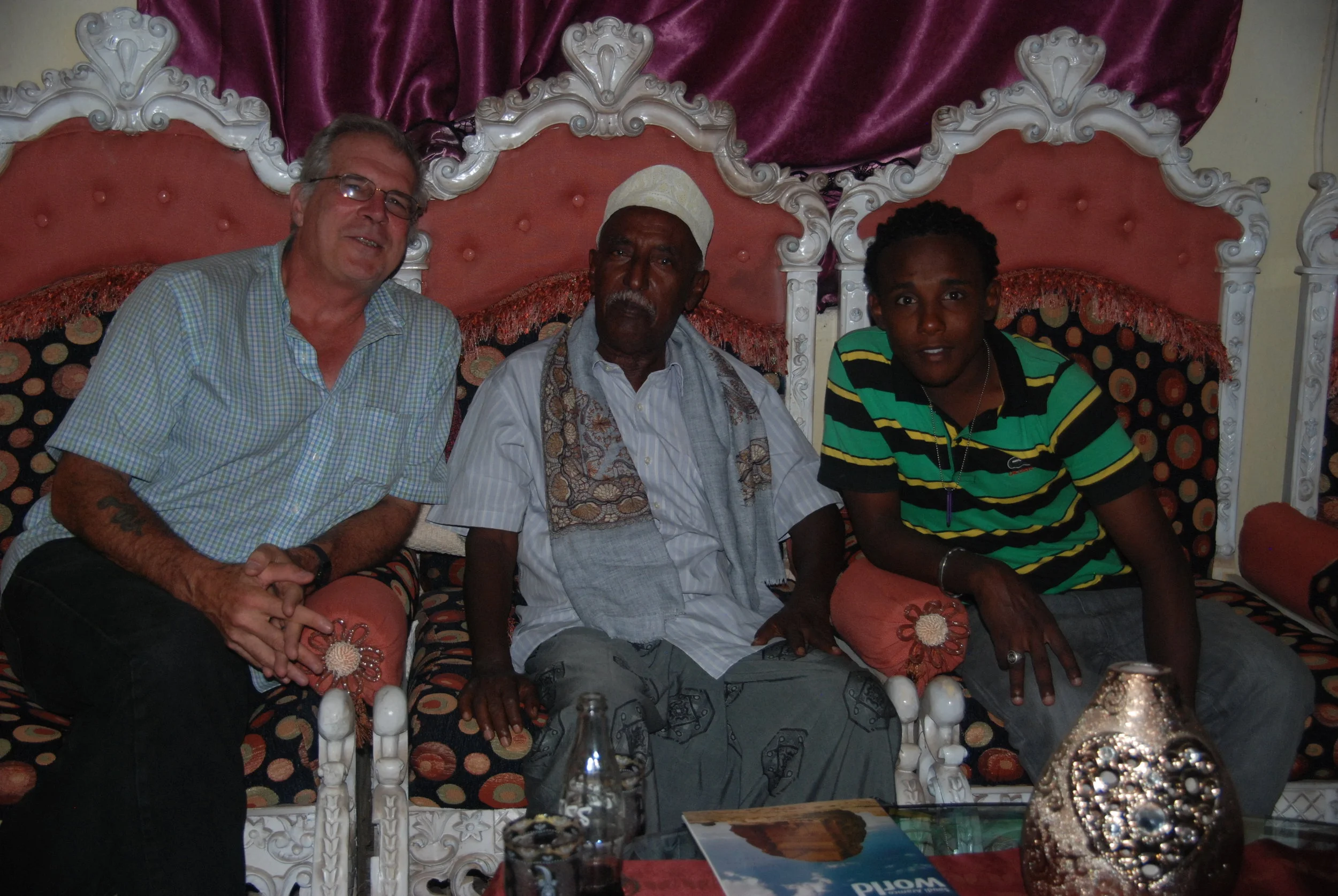
Nineteen years ago I was first in Tajourah, I stayed with the Sultan in an extra room of his house. It was Ramadan so the evening hours were filled with visitors to what passed as his throne room, a bare hall with cushions thrown against the walls. Much coffee, much tea, much qat. I asked the Sultan a few questions, about his duties, when as a shaman he assumes the form of a hyena to prowl through his realm looking for the news of the night.

I lost the thread of his French, my translator’s mouth was full of leaves so he couldn’t talk much anyway, and I wandered into the room next door where the hurma, the hareem, the womenfolk were watching satellite tv, from Paris, a show dubbed into French called My So-Called Life, written by a college classmate. I stuck with the women and Clare Danes over the hyena in the men’s room- their stories, their chewable stimulants, and their guttural Afar exclamations could wait until my other life called.

Fast forward ten years to 2010, I was back in Tajourah with an American tour group, I asked our driver to set an audience with the Sultan, it was agreed and we arrived and took our seats, now in a proper throne room with high back chairs ringing the perimeter. I told the Sultan that I had met him before, that I came to give him greetings and for him to meet retired Americans, all over 65 years. The group introduced themselves one by one, some were former lawyers, some former bankers, one had worked on a Detroit assembly line.

When we were exiting the room, an aged retainer stepped forward, he said that he recognized me from before, he told me in which room I had slept and what questions I had asked. And he remembered that I liked to watch television, beaucoup de télé.

The Sultan and Me

The Sultan and Me

A Maharajah Without Elephants, as Best I Can Remember

Oh, come on Mother. It’s going to be a great adventure. A maharajah, we’re going to be the guests of a maharajah. Why, he’s so rich I guess he just has no idea how much money he’s got. And jewels. And elephants. Only think.”

-from The Murder of the Maharajah by H.R.F. Keating

New Years Eve 2006, we and the children were invited to celebrate at the Mehrangarh Palace with the Maharajah of Jodhpur, as were all guests at his Umaid Bahwan hotel. Seventeen foot long turban wraps were distributed to men and boys alike. I had previously shaken hands with the maharajah in London while visiting an art gallery which every Saturday at closing hosted bridge games- I was there to look at art, not to play.

A bus took us up the rocky crag to the steeply pitched and portcullised front gate. From there we walked, the children almost skipping. On the curving and corkscrewing approach to the palace proper we passed side niches staffed by singers, shenai players (Bismillah Khan had died that year), hijra dancers, and most important, attendants bearing ewers of opium water poured directly into the guests’ cupped hands. I slurped like a horse, not like a cat that was expected of me, and I recall little else of the evening. Ask the children for details. There were likely to have been jewels. Even I would have remembered the elephants, which I do not.

Will Buttigieg Lay an Egg?

Il-bierah kilt tiġieġa u llum bajda moqlija.    Yesterday I ate a hen and today a fried egg.

It-tiġieġa hija u tixrob tiżżħajr ‘l Alla.  The hen when drinking gives thanks to God. [because it always lifts its head high afterward]

Tiġieġa hawtiela bajjada. An active hen is a a good egg layer.

-from A Comparative Dictionary of Maltese Proverbs, Joseph Aquilina

Abu Dajaj [Father of Poultry, from Arabic], Buttigieg, Tiġieġa…look familiar?

Buttigieg is a common surname in Malta’s smaller island of Gozo, which if true makes Mayor Pete a Gozitano. I remember spending a cold rain-drizzling afternoon in an English pub in Gozo’s main town of Victoria- renamed from its Arabic-derived Maltese toponym of Rabat- after seeing in the nearby Museum of Archaeology the Maymunah Stone, a 12th C. Arab period headstone with an inscription extolling the deceased, a girl named Maymunah who died March 21, 1174, carved in Kufic letters on the back side of a Roman era marble slab with a rose carved on the front.

The inscription reads…

“In the name of Allah, the merciful and compassionate. May He be propitious to the Prophet Muhammad and to his followers and grant them eternal salvation. God is great and eternal and He has decreed that his creatures should perish. Of this the prophet of Allah bears witness. This is the tomb of Maymūnah, daughter of Hassān, son of ‘Ali al-Hudali, known as Ibn as-Susi. She died – Allah's mercy be upon her – on Thursday 16th day of the month of Sha'ban in the year 569, professing that there is only one God who has no equal. Look around you! Is there anything everlasting on earth; anything that repels or casts a spell on death? Death robbed me from a palace and, alas, neither doors nor bolts could save me. All I did in my lifetime remains, and shall be reckoned. O He who looks upon this tomb! I am already consumed inside it, and dust has settled on my eyes. On my couch in my abode there is nothing but tears, and what is to happen at my resurrection when I shall appear before my Creator? O my brother, be wise and repent.”

Buttigieg said he picked up some Arabic as part of his military training. But maybe he has Arab blood in his veins dating from Maymunah’s time….Was perhaps one of his Gozitano ancestors known as Abu Maymunah before he became the Father of Poultry?

A Clammy, Swooning Climate on the Hot Seat

Anuradhapura..."Those great assemblages of pillars, the storied Mahawansa, the humped dagobas, are not excessively beautiful in themselves, in spite of carved balustrades, 
carved moon-shaped stone slabs, sculptured Buddhas and ele- 
phants; what gives them aesthetic charm is their situation, jungle- 
surrounded, barely reclaimed, the green sward on which they 
stand, the scattered lakes, the delicious stone baths, the clammy, 
swooning climate which lies like warm, scented flowers on forest 
and clearing, the frisking monkeys, and, above all, the long reaches 
of the mysterious, exotic past, winding like a dimly seen river 
through green enjungled silence to the gorgeous heyday of 
royal and priestly magnificence of two thousand years ago, and 
beyond that to the earliest beginnings, when the bo-tree took 
root." 

-The Pleasure of Ruins, by Rose Macaulay

I felt no clammy, swooning climate or warm scented flowers- just raw, dry, baking heat. I heard no enjungled silence, only a pilgrim’s inner voice saying Ouch! Ow! Ouf! as he hurried in bare feet along the hot bricks of the sun-drenched path. The green sward was parched to brown dead grass, the delicious stone baths were half evaporated, and the fresh lime plaster of the humped Ruvanvelisaya dagoba blazed dead white under the midday sun.

Rose Macaulay was the queen of overstatement on the subject of the best and biggest of all the world’s ruined building, but she did not personally visit everything she wrote about. Not Anuradhapura certainly, for even sixty five years ago when she was writing The Pleasure of Ruins the jungle had been cleared and the ruined stupas had been fully reclaimed.

To walk from the shaded precinct of the bo tree to the Ruvanvelisaya stupa takes only ten minutes, but each step seems an eternity with bare feet on the brick paved path’s heated iron griddle. I should have worn socks or even better five finger running shoes. That may have fooled the watchful monks enforcing the stupa’s visitation rules, and certainly made it easier for a visitor such as I, so easily distracted from the highest sublime towards my lowest bodily part, to concentrate on the Buddha’s sacred footprint rather than on my own scorching feet.


depositphotos_136955778-stock-photo-the-elephants-at-stupa.jpg

To Mopti- With My Bootlace Up the Muffler

“…I had but little hopes of subsisting by charity in a country where the Moors have such influence. But above all I perceived that I was advancing more and more within the power of those merciless fanatics, and from my reception at Ségou I was apprehensive that in attempting to reach even Djenné, I should sacrifice my life to no purpose, for my discoveries would perish with me. The prospect of either way was gloomy.”

-The Travels of Mungo Park, 1799

My friend and I were in Bamako and needed to get to Mopti in a hurry, but with a few stops in between where we wished to make them, and when. I let out word at our hotel that we would hire a car and driver for a single day outbound. When the jalopy pulled up in front, I winced but checked its tires and dipsticks. OK they seemed. The driver was a young kid, he gave me a line that it was his “friend’s” vehicle, that it ran well, we could leave whenever I wanted and we’d be in Mopti by nightfall even with our planned stop overs.

We set off to the east towards the town of Ségou- a name familiar to any high schooler ever assigned to read but didn’t Maryse Condé‘s novel of the same name- where we planned to buy kola nuts to give out to the Tuareg chiefs in the Gourma region’s elephant country under the Boucle du Niger, the Niger River’s Buckle where it turns sharply north then immediately south again.

After Ségou we made sure to see Djenné, famous for its mud mosque but a bit off piste. But oh boy, the pneus and the chambres à air, they kept popping, puncturing, deflating and flattening, and we kept stopping at every roadside fix shop on Mali’s RN6. A dollar here, a dollar there, an hour here, an hour there, and we were way behind whatever schedule you try to keep in Mali. I came up with a few choice curses from way back, most beginning with the word maudit- in fact, not so bad. The driver just shrugged.

Just when we thought we were in the clear to fly down the Route Nationale, the muffler started dragging, grinding on the tarmac and sparking up enough to start a fire. We pulled off and the driver looked underneath, shrugged some more, I told him we needed wire to hold it up. Pas de fil, pas de cable, said he.

I untied my bootlace and handed it over, he crawled under and tied it up. We got to Djenné just after dark, the mosque’s facade was dimly illuminated as if by magic fairy bulbs, we got beds in a fleabag for the night, and at dawn found the mosque’s plaza multi-colored with marchandes wearing the most wildly electrified m’boubous under the Malian sun.

We got to Sévaré, Mopti’s crossroads, by noon. The driver wanted to be paid for the extra day, I told him it was his fault we were a day delayed but I paid double anyway, plus a tip. Just before he pulled out, on the hunt for return Bamako fares I guessed, I asked for my bootlace back. He shrugged for the last time, ducked under and handed it over, and burned the little rubber left he couldn’t afford to lose with a tire screech and the muffler’s sparks flying out behind like from a roman candle. At least my boots fit well again. I’d need them later in the boucle I guessed, and I was right.

Djenné Mosque

Djenné Mosque

Arriving Agades in the Dark

“The road was now becoming frequented; and my companions with a certain feeling of pride showed me in the distance the high “Mesallaje”, or minaret, the glory of Agades…But arriving at a new place at night is never very pleasant and must be less so where there are no lamps; it therefore took us some time to make ourselves fairly comfortable…Having spread my mat and carpet on the floor, I slept well, in the pleasing consciousness of having successfully reached this first object of my desires, and dreaming of the new sphere of inquiry on which I had entered.”

-Travels and Discoveries in North and Central Africa, 1848-1855, Henry Barth

Barth arrived in Agades, the first European ever to do so, in the dark as did I. My friend and I had pulled into Niamey on a two day bus en brousse from Gao and needed to hurry on to Agades. The station master said we had to wait for a 9 person van to fill and it would leave immediately after, I told him we would pay for an additional seat each, so we needed 5 more passengers before setting off on the overnight drive.

I was impatient, it was getting late, but was told that few ever started that long trip- about 15 hours- in the evening. Better to wait til morning, he said. I knew from reading Peace Corps veteran Peter Chilson’s harrowing book on Nigerien bush taxi drivers, Riding the Demon, not to press one’s luck on the road at night.

I said we would pay for the whole van, all nine seats, so he rounded up the driver and co-driver and we set out from the bus parking. At the exit a few men were standing by hoping for a part way lift, which were not permitted from inside, but it was up to each driver to say yes or no once underway. I told the driver to consider the entire van full, no room at all, and any empty seat he saw had a phantom passenger I had paid for. But a boy stood out from the crowd at the gate, he said he was going pretty far up the road, to Dogondoutchi or some such place, so I told him it was ok to get on.

About an hour outside of Niamey, as dusk was settling in, we pulled off to eat in a roadside joint and bought plates of meat for the boy and the drivers. When dark was nearing we set out again, and I dozed off across the 3 person rear seat with my friend stretched out in the middle seat.

I didn’t know what finally woke me up, but when I came to I was squeezed upright between three people in the rear, my friend was squeezed the same way in the middle, and there must have been at least fifteen of us altogether. The drivers and the front seat passengers were having a loud conversation.

We were moving fast on a narrow tarmac road, good goudron as they said, through open ground, no electric lights, a few lamps lit at roadside. My watch read after midnight, a good 7 hours after we first set out from Niamey. Brighter lights ahead, Tahoua, halfway to Agades, from here forward bare desert another 6 hours. “We rest here a bit,” said the driver, “Don’t leave your seat, or we may leave you.”

I think I counted the time until we left, it was less than an hour, and we were back on the road in our flying coffin, as share taxis are called in Egypt. My legs were bent and achy, I elbowed my seatmates to mover over, to no effect. It was my van after all, all mine, but I was outnumbered. One in fifteen, or two in fifteen if you counted my friend in the middle seat, lucky to be deep asleep.

Dawn’s first streak came as we barreled down the Agades Depression toward the Aïr Massif which stands behind the town like a bodyguard and the sun was inching up when we pulled through the scrappy outskirts into the city center. And there it stood- tall, mud plastered, stuck with wood spars like a pin cushion- the minaret of Agades, the sight I had come all this way through the night to see. Now for breakfast, having wished that I, like Barth, could have slept on the floor last night.

agades.jpg