Would KhairAllah Really want a Sage Like Me?

It appeared to my mind impossible and contrary to all sound custom that so good a knight should have lacked a sage to undertake the writing of his unparalleled achievements, since there never was one of those knights errant who go out on their adventures that ever lacked one. For every one of them had one or two sages ready at hand not only to record their deeds but to describe their minutest thoughts and most trivial actions.

-Don Quixote, Part I Chapter 9

In Arabic, a faaris is a knight, a horseman, from the Arabic word faras, mare. KhairAllah was a camelman but nonetheless I thought he needed a sage. I wrote about him in 1984 and made a film about him in 1988. I always called him batal al-shaasha, hero of the screen, and wanted more than anything to show the film Sawt al-Sawt, Voice of the Whip, at el Obeid’s outdoor cinema Arous al-Rimal, Bride of the Sands. It was not to be because when the film was finally finished, VHS had killed commercial cinema even in rural Sudan.

I thought that the film review in American Anthropologist was a snarky hit job. The reviewer must have attended a screening at the Margaret Mead Festival when from the stage I tossed out a throw away line about “the romance of the road” and my childhood desire to ride the Chisholm Trail, because he called me a starry eyed dilettante with no business making self-styled ethnographic films. This was the same guy who lied about his religion to his informants when writing his own ethnography of Arab nomads, in order as he said to fit in better.

At least he correctly picked up on the title’s wordplay, which reverses its Arabic consonants’ near homophones t and s- in Arabic, t and s both have emphatic and plain versions and create totally different words. Arabs like clever manipulations of their language, even illiterate Arabs.

I never once told KhairAllah that I was a Muslim and I never dressed as an Arab, much to my regret when before the forty day mark my blue jeans became so oppressively dirty that I wished I had worn a pair of sirwal, light breathable cotton riding pants, like my college friend Steve wore. Steve is Jewish and gave himself the Arabic name Mustafa, meaning the Chosen One, as the Prophet Muhammad was called, in order for the drovers to always remember his name. To fit in better, he thought. It gave us both great pleasure around the campfire to tell the men, No, Mustafa is not Muslim, he is Jewish. He just chose the name, the Chosen One, because he likes how it sounds.

It reminded me of the anecdote told by my graduate school teacher, a State Department adjunct originally from a small town in Oklahoma, who said by way of trying to open our eyes to cultural difference, Back when I was in high school, we had a Djew, an A-Rab, and a Terk, and we all got along OK. All I could later say was, You should have been around our campfire on the darb al-arba’in.

Waste Not, Want Not Nigh of al-Wiz

I’d forgotten it had taken me twelve hours in 100 degree heat on the train to reach El Obeid from the River Nile.

-African Calliope, Edward Hoagland

Muhammad was the most miskeen, the most wretched drover on my first trip. His riding shirt was the most ragged and he always ate last, having had to run after the most distant wandering camels before they were all hobbled. Once when we were just outside Hamrat al Wiz, he jumped off his camel when he spied a rusted tobacco tin half buried in the sand. He said he could keep his chaw in it, too poor even to afford to buy Abu Fil, Father of the Elephant cigarettes. That old tin reminded me of the story of the Mahdist sword scabbard found after his army was wiped out by the British in the Battle of Omdurman, 1898, that had been repaired with a strip of sheet metal from an imported English biscuit tin.

My cousin Kennett Love was visiting my house in St. Louis the same day my Sudanese friends Hashim and Umalhassan were visiting from Jefferson City. Kennett joined us on the riverside, with a view just upstream from the confluence of the Missouri and Mississippi Rivers, which I told Hashim was just like the Mugran al-Nilayn, the meeting of the two rivers in Khartoum.

Kennett asked where they were from and they said Sudan. He asked where abouts in Sudan and they said El Obeid. I’ve been there, he said. Back in the 1960s. Umalhassan and Hashim were quite amazed. They had lived in Missouri long enough to know that few people there had ever heard of Sudan, much less knew where Sudan was, even less El Obeid, much less had ever been there. Me and Kennett, that made two Missourians who had been to their hometown.

Kennett told the story of how he had gone there as a reporter for The New York Times. In those days there was no paved road so only high clearance four wheel drive vehicles could get through. He was in the back of a Bedford lorry with a bunch of men and he was just finishing a bottle of whiskey which he threw out behind. He said there was a great shout and the lorry screeched to a stop, two men raced back to get the bottle, one came back with it and the other empty handed. A glass bottle. Something precious. If he had taken the train like Hoagland he would have missed it.

The Arabic verb to store or to warehouse something is khazzana, which by extension means to chew tobacco, as in, to keep tobacco in one’s mouth. An Arabic noun from this is makhzan, a storage place. The French word magasin comes from this, as does the English word magazine, as in an ammo or gunpowder magazine. I once went to the roof of a department store in Paris and thought of Muhammad chewing his chaw. The view of the Seine was nothing like the Nile and the Galeries Lafayette was nothing like his tobacco tin, or a high capacity ammo magazine like we see today.

I need a translator for my translation

This is how the discovery occurred…in one of the parchment books the lad was selling I saw characters I recognized as Arabic. But though I recognized them I could not read them and looked around to see if there was not some Spanish-speaking Moor about to read them to me; and it was not difficult to find an interpreter there. In short, chance offered me one to whom I explained what I wanted, placing the book in his hands. He opened it in the middle and after reading a little began to laugh.

-Don Quixote, Part I Chapter 9

We were in the middle of nowhere when a lone rider approached to palaver with KhairAllah. I could not follow the conversation in real time but finally KhairAllah turned to me and spoke in the pidgin Arabic that he thought I spoke and thus would understand better than his dialect. He said that this man had lost three four year old camels two days ago and wanted to write a letter for another man in another group to pass to a third man who was coming up behind. KhairAllah asked me to put all this down with pen and paper.

I didn’t know why just passing a verbal message from man to man would not suffice. After all, this was the land of oral transmission. But I wrote it as best I could, getting the salutations and invocations right at least. In the name of God, Praise be to God, Greeting Upon You, etc. etc. I probably scrambled the message itself.

That letter floating around the desert from the hand of one illiterate camel drover to another will be a collector’s item someday. Just like the postcards I liked to send back to the States from rural post offices in distant countries, some with good postal services like India, some with not such good services like Sudan. In fact most of those postcards would eventually arrive at their destination, to my kids back home, and I would marvel at the untold number of men, to me strangers all, who had to pass those cards from hand to hand in order for my children to get to read them at the far end. Like a game of telephone that works out to the very last syllable. Greetings from Sudan. Love, Daddy.

A Taste of Sheeya

“Grilling is by far the world’s most common live-fire cooking method, practiced on six continents by rich and poor alike. Grilling is essentialy the same whether it’s done over a campfire-size pit in Argentina or on a shoebox-size sate grill in Bali” [or over a gum arabic wood fire in the Sahara Desert by four Sudanese camel drovers en route to Egypt who are dead tired of eating nothing but millet porridge.]

-The Barbecue Bible

In Egypt I learned the word for grilled meat, mashwee. It was always a cause of celebration, and it always meant lamb, and you ordered it by weight- a quarter kilogram if you were feeling dainty, a half kilo if you were feeling hungry, and a full kilo if you were famished- in grill restaurants. The word comes from shawaa, a doubly weak verb, meaning that two of the three consonants in its tri-literal root are waw and ya. After eating a kilo of mashwee, you always felt doubly strong, not weak.

The camel drovers call grilled meat sheeya, not mashwee, which is just another arrangement of vowels inserted between that same tri-literal root’s consonants, which sometimes go silent but never disappear. They rarely eat it on the trail because it’s hard to come by in the desert. Millet flour is easier to carry. We once bought a goat and once butchered a camel. Then we ate sheeya and the fatty meat tasted really good in that dry place.

When we arrived in Cairo I invited the men into downtown to eat and shop. They bought wool shawls outside al-Azhar and window-shopped in the Muski. The highlight was sitting down in a grill restaurant to eat sheeya, or mashwee as we called it there. My old dictionary has the word shawwaa, meaning grill man and is a noun in the occupational form of its doubly weak tri-literal root.

Sawwaaq, meaning driver (or drover), is another example of a noun in the occupational form, which always doubles its medial consonant and elongates its following vowel a. Saaqa is its verbal form and because its medial consonant is wa, a weak consonant, it is called a hollow verb. You could say that the drovers that day really were hollow. Their stomachs were empty and they were famished. A kilo of sheeya per person kind of hunger.

I did the ordering, saying to the waiter, talata kilo, then kamaan itnayn kilo, then wahid kilo kamaan, then kilo taani. The kilograms added up. I think we got to eight for the eight of us at the table. The bill came to about half of their pay for their forty day job. They could not believe how much money I handed over. Fulous kitiir, sheeya galeel. A lot of money for a little grilled meat.

People of the (Please Re-) Wind

I became Kalantar at the age of 20, in those days I had to fight my way through these mountains. I lived with my own armed gang and we punished those who did not respect us…Ali Aga has told his men he wants them to kill a fat young sheep. He wants to make an impression. I accept Ali Aga’s hospitality but it doesn’t make me forget that fight a few years ago. It was caused by a cow.

-The Babadi tribal Kalantar (chief) Jafar Qoli, voiced by British actor James Mason, in the documentary film People of the Wind (1976), about the spring migration by sheep and goat pastoralists of the Bakhtiari tribal confederation

A staggering trip. The film fills and stuns the eye. Remarkable!

-Los Angeles Times

There are two hundred miles of raging rivers and impassable mountains to cross. There are no towns, no roads, no bridges. There is no turning back.

-publicity material, DVD release

I had grown up looking at a 16mm Castle Films short of the silent documentary film Grass (1925), about the same migration route filmed in People of the Wind fifty years later, made by the same co-directors who made the Hollywood movies King Kong and Mighty Joe Young. It stuck me on the idea of animal migrations still made across long and hard open spaces in modern times, and some years later I heard about this film. It had not been commercially released despite being nominated for an Academy Award, it was hard to find in the educational market, and few people outside anthropology circles had ever seen it. Those who had, said it was great, a worthy successor to Grass.

When I was thinking about how to edit Voice of the Whip in the mid 1980s, my partners and I discussed our options how to present recorded dialogue and testimonial. Subtitles? Voice over? With what kind of English language voice artist? Arabic accented or not? With the field recorded sound audible or inaudible? Textually accurate or loosely edited?

I wish I had been able to have seen People of the Wind at that time, but it was not released on DVD until 1999. If I had been able, it would have answered a thorny question about the ethics of representing reality in ethnographic filmmaking- which of the two, subtitling or voice over, is the closest to the lived truth, both at the time of filming and on screen?- because it uses the plummy voice of James Mason, unforgettable in Lolita, North by Northwest, Quentin Tarantino’s blaxploitation favorite Mandingo, and Genghis Khan in which he played a Chinese nobleman. Mason’s voice answered my question.

In the documentary, Mason speaks the well crafted lines of a tribal chief’s imagined interior monologue, with perfect Oxbridge diction and the best RSC dramatic effect. And this got me thinking- what if I had gone that route for Voice of the Whip, with Hollywood actors voicing the lines, maybe Robert De Niro as KhairAllah, Samuel L. Jackson as Bilal, and a gaggle of B listers for the others.

KhairAllah might have turned to Yousef, the headstrong apprentice khabir who challenged him for being too old and too slow to set the pace for the others, and asked, You talkin’ to me? Or we might have remade What’s Up, Tiger Lily? along the darb al-arba’in, with forty thieves led by Phil “KhairAllah” Moskowitz on a forty day trail delivering forty camel loads of egg salad to Egypt…

download.jpg

Let scent hounds sleep

My dog, by the way, thinks I have much to learn about partridges, and I agree. He persists in tutoring me, with the calm patience of a professor of logic, in the art of drawing deductions from an educated nose. Perhaps he hopes his dull pupil will one day learn to smell.

-A Sand County Almanac, Aldo Leopold

Olefacio ergo sum

-with apologies to Descartes

Perro Bravo. Cilgin Kopek. Boser Hund. Txakur Txarra. Caine Rau. Plokhaya Sobaka. Gos Dolent. Chien Mechant. Warui Inu. Droch Mhadra. Cane Cattivo. Kelb Hazin. Qen i Keq.

Many ways to warn about a bad dog, but basset hounds need no warning, because they are never bad. Cave canem? No need if he has velvet ears, knock kneed legs, rheumy eyes, and twitchy nose when napping. What is he sniffing in his sleep? Himself? Some hole in the ground? A day old rabbit trace?

I had travelled late into Christmas Eve to reach Antigua Guatemala and the next morning in the Parque Central I saw two leashed and well groomed bassets sitting near the life size creche. Camels, donkeys, sheep- the manger had been almost full. Now it was. The gift of the Magi… Bark! The herald angels sing…On the first day of Christmas my true love scent to me…It’s getting to smell a lot like Christmas…

A Saharan fish tale

fils (pl. fulous). A small coin, an obolus or anything of similar shape; as the scale of a fish, the boss on a bridle or book

-English and Arabic Dictionary, Joseph Catafago, 1873

I had never considered that my use of the word fulous, which I always meant and understood to mean money as a collective noun, was actually the plural of the singular noun fils, which had a secondary meaning as any object shaped like a round coin, such as the decorative brass buttons attached to a horse bridle, or the iron bosses that covered the outside of doors along a public street, or fish scales.

A common response to a beggar is fulous ma feesh, there is no money, which might also be translated in a jokey bilingual way as money, not fish. Some Sudanese used an alternate word, qirsh (pl.quroush), meaning the coin of 1/100th the value of a guinea. In Sudan and Upper Egypt, the letter q is pronounced as a g, so guroush ma feesh is as commonly heard as fulous ma feesh.

Either way, the scale of a fish or one hundredth of a pound, a fils or a girsh was not much to fill one’s pocket, jaib (pl.juyoub), as in that belonging to my friend Abu Jaib, one of the wealthiest camel merchants in Sudan at one time, so wealthy that a camel drover I knew, Mas’ood abu Dood, told me that Abu Jaib would send a herd of female camels with a single bull and a few drovers to look after them for a year or two into the desert, telling them not to return until they had all foaled, and in that way he would double his fulous, which in the desert is as hard to come by as either a fish or a girsh.

a goat hair tent, a mud hut, or a $9,000/night honeymoon suite?

But who had ever heard of a honeymoon house made of mud?

-Guests of the Sheikh, Elizabeth Fernea

Why Dubai is a dreamy honeymoon destination. It’s an easy transition from any American city, while still feeling wildly exotic and exciting for those seeking romance. Arabian design is grand, royal, and enticing…high ceilings, arabesque archways and intricate lanterns…dripping in diamonds, 24 karat gold leaf, 30 types of marble and a revolving bed…which starts at almost $9,000 per night…other musts- a journey into the desert which may include a camel or two…with a bottle of bubbly, of course.

-Brides Magazine, April 15, 2017

We were three days past the Ma’toul wells and the desert colors had faded to a dull dun. All day. Nothing to catch the eye. A few hills and low spots in the wadi, but all dun. Suddenly, white. Something white at the top of the rise. It looked square. A tent.

Shahr al-’asl, yaniiq kitiir, said KhairAllah. Al-’ariis ta’baan tul al-yom. Month of Honey, much fucking. The groom is tired all day long, he laughed. So this is what a newlywed Kabbashi couple does in their first month, pitch a tent and never sleep. Who feeds them, I asked. Their people leave them food beside the tent fly. Fucking food. Meat and basbousa, eggs and milk.

At the aseeda bowl later that night, I looked at the leftovers. Gummy hunks of boiled millet flour. Cold smears of cooking oil. A stray fried onion. I wanted my second honeymoon to start that very night. I would even agree to marry Mas’ood abu Dood, he of the crooked rotten teeth and ragged riding shirt. Meat and eggs sounded pretty good when you can’t choke down one more bite of millet paste. A month of honey, and we had thirty days of trail ahead of us. Put the bubbly on ice for later, much later.

wrap your head around that!

On one road alone, I saw thirty men in voluminous turbans. I was in headwrap heaven. Geographically, of course, I was in…

-Headwraps: A Global Journey, Georgia Scott

In a niqab, they can’t tell if she has a ski jump nose or bee stung lips. In a burkini, they can’t tell if she has a thigh gap or a six pack. In a hijab, they can’t tell if her hair is blonde, brunette, or hennaed. In none of those can they tell who she really is, especially if she’s in a burqa and doesn’t speak or shake your hand. Speech recognition software and finger print analysis cannot outwit the 10th century. The police don’t like that, especially the French fashion police.

I was equally thrown by men in turbans. They all were wearing them, when I first met them and always thereafter. I associated their turbans’ folds, color, size and state of cleanliness with their eyes, nose and teeth. All were essential inputs in my own facial recognition system.

But on the trail, when sleeping or washing next to these men, they took off their turbans and I was frequently shocked by what I saw underneath. No hair! Gray hair! Skull bumps ! And I had a hard time recognizing who was who, as if the beardless ones had suddenly grown beards, and the bearded ones had suddenly shaved. If the men were no longer mu’ammam, turban wrapped, how could I tell which ones were my ‘amm, my uncle, the courtesy name we called our friends among the group.

If it is true that the turban really does make the man, then the man with no need for a burial shroud wrapped on his head is an angel. The shroud of Turin is 14 1/2 feet long. Natural cotton shrouds sold for organic funerals are 15 feet long. Both twice the height of a man with tail ends long enough to wrap two times around the body and then tie it off.

I never saw a turban that long in Sudan. Maybe the camel drovers didn’t think of their headwraps that way. Maybe sometimes a turban is just a turban. As that college dorm poster of Sigmund Freud with the dual use bushy eyebrow put it, What’s on a man’s mind. Eros, Thanatos, a glass of tea with plenty of sugar….I always knew what the drovers were thinking about, and it wasn’t either of the first two.

A haunted Desert

The desert can be a scary place at night. Darkness descends very quickly upon the barren landscape. The night brings with it a bone-tingling chill. But it is the silence that is most unnerving. The slightest noise is amplified tenfold as it echoes across the vast empty spaces. The wailing of a lonely jackal sounds menacing…’This is not a good place to be in. I have heard stories about this place…it’s haunted.’ The others hushed up, looking around nervously for any sign of the supernatural. The sudden sound of creaking metal startled all of them, making two of the men spill their tea.

-The Spinner’s Tale, Omar Shahid Hamid

Many times as we sat around the fire at night with the camels crowding in always closer, we talked about ghosts and demons, genies and specters. The wind often blew with strange effect along the sand, making it moan and sometimes almost laugh. The word we used most to describe these frights was ‘afreet. But what we heard most was the ‘afeet, farting, of the camels. They were all around us. They had us surrounded. We huddled closer to the fire. We could not get away, but we felt better about our miserable situation alone in the desert, short on sugar and firewood. The ‘afeet would protect us from the ‘afreet, someone said. All we had to do was to hold our noses and not spill our tea.

I am dazzled

I am dazzled by a Frankish woman whose body exudes sweet perfume,

A sweet-smelling branch has slipped beneath her dress,

And her cape is made of the silvery moon.

Her eyes are as blue as the glinting steel of a lance.

-Ibn al-Qaysarani, or Son of the Caesarean

This lyric from a qasida by Ibn al-Qaysarani (1056-1113) known as Ibn Tahir of Caesarea was sung and recorded on the album Arab Music from the Time of the Crusades by the Al-Kindi Ensemble, led by the late Julien Jalal Eddine Weiss. The album has a photograph of the Aleppo citadel, the city’s symbol but because of the war now much damaged, on the cover. Julien and his takht, a grouping of soloist-quality classical musicians, had previously recorded The Aleppian Music Room in his own 16th century house in the old city, featuring a central domed room with circular second floor balconies, which had been rehabilitated by the architect, preservationist, and urban historian Khaldoun Fansa.

In the fall of 2003 I attended a concert there as Khaldoun’s guest. I do not remember the singer’s name but it may have been Omar Sarmini who sang on the Crusades album. The room resonated through the night with the driving notes of Julien’s qanun and the hand drums, flute, and oud. The piercing lyrics rose to the top of the dome near where I was sitting in the balcony and nearly loosened the keystone. I was dazzled. Or better said, to translate that first part of the lyric- laqad fatinatni- more precisely, she seduced me.

King Hiarbas Threatens Dido, and All Foreign Women like her everafter, for Spurning Him and his Fellow Moors

He, when he heard a fugitive could move
The Tyrian princess, who disdain'd his love,
His breast with fury burn'd, his eyes with fire,
Mad with despair, impatient with desire;
Then on the sacred altars pouring wine,
He thus with pray'rs implor'd his sire divine:
"Great Jove! propitious to the Moorish race,
Who feast on painted beds, with off'rings grace
Thy temples, and adore thy pow'r divine
With blood of victims, and with sparkling wine,
Seest thou not this? or do we fear in vain
Thy boasted thunder, and thy thoughtless reign?

-Book 4, The Aeneid, John Dryden trans.

King Hiarbas gave his love to Dido the Tyrian princess when she arrived on his North African shore in flight from Phoenicia fearing for her life, but she preferred the Trojan fugitive Aeneas, and he her, so Hiarbas invoked the anger of Jove who had long protected his god-fearing people. Foreign women unwilling to be faithful, he declared, must forevermore sacrifice their blood in order that such sexual humiliation be avenged.

Maybe Raphael Patai, author of The Arab Mind, a study of Arab psychology from the school of so-called “diaperology”, as was Ruth Benedict’s The Chrysanthemum and the Sword, by which an entire people are reduced first to the shame of their toilet training and later to the humiliation of their initial sexual stirrings, was on to something real- not just the bad Freudian joke that Patai’s work and all diaperology is known as today. And maybe Virgil got there first with the idea that Arabs, Moors, Numidians, Garamantians, Gaetulians, Berbers, etc. all have the same kinds of problem with foreign women, especially those who reject or are unfaithful to them with other men. Othello, in whose painted bed lies Desdemona tonight?

Boy scouts earn merit badges in nuremberg, nc

Greenville, NC. July 17— Some raised campaign signs or fists to the rhythm of the crowd as they yelled. A few were children, following the lead of the adults sitting in the front row seats behind President Trump. “Send her back! Send her back!” they yelled in unison.

-The Washington Post

Continuing a downward trend in the rankings of the Tar Heel state…in a new report card on public education, North Carolina received a C- grade and a score of 70.6 out of a possible 100 in the 2018 Quality Counts Report…below the national grade of C and score of 74.5…40th out of the 50 states.

-The News & Observer

Those who cannot remember the past are condemned to repeat it. If you’ve never been taught about the past in the first place, you won’t feel bad for not being able to remember your own state’s long history of lynching. Or the Holocaust. “Send her back!” ?- they’re not talking about the MS St. Louis and its Voyage of the Damned, are they? And oh yeah, Santayana sounds like a Mexican name, or sumpin’.

18onpolitics-pm-articleLarge.jpg

Papa don't preach just 'cause you can't sin no more

Les vieillards aiment à donner de bons préceptes pour se consoler de n’être plus en état de donner de mauvais exemples.

-La Rochefoucauld

Less rib eye, more shut eye, less red eye. More chicken, less bacon, no bakin’. Eat the fish and cut out the bait. Is it still good advice if no one listens to the sound of one hand clapping? Today’s top news is on the bottom of tomorrow’s canary cage. And the day after, it wraps a dead duck. Don’t replay late night jokes if you miss them live- backing up isn’t worth the punch. Onward Christian soldiers. Aux armes, citoyens. The first one to leave, remember to turn out the lights. It’s better to live in the dark than to die at the dimming of the day. Bons préceptes, n’est-ce pas? Vive la vie, Ô Vieillard!

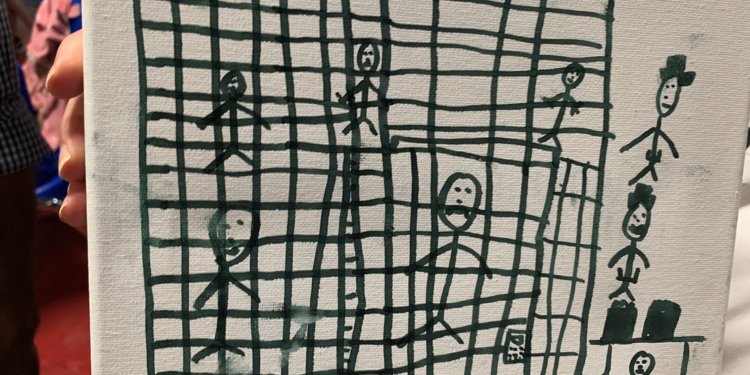
His pen pens them

An escape-proof stockade of a presidential signature. A signing statement that cages children behind its own black ink metal bars. Executive orders that order indefinite lock-up until they want to go home and sleep in a bed. No hot meals, no clean clothes.

How to decipher that paranoid palisade of a signature? Does it say, Keep out! Does it say, Merry Christmas, from Grandpa? Does it say, Throw away the key! Does it say, I am as angry as this Rorschach test says I am, the one I just scribbled over with a Sharpie? Does it say, I really don’t care, Do U? Does he even know what it says, about America, to others? Their drawings are not all heart-breaking. Some show blue skies and happy faces. Children, they say, are resilient. But are we?

Donald_J._Trump_signature.svg_.png

Two Louis Werners, One a Typo

James Joyce name drops not one but two Louis Werners, one in the Hades episode and one in the Clashing Rocks. The Werner spelled correctly is billed as the conductor and accompanist of the touring American actresss Mary Anderson at Ulster Hall on the night of 16 June- Bloomsday- 1904 performing Juliet’s Balcony scene, and the other Louis, misspelled as Lewis through a typesetting error, owns a house with cheerful windows at 31 Merrion Square North at the corner of Holles Street- just across from 39 Merrion Square where the British Embassy was fire bombed and burned during the Bloody Sunday protest- who according to the Dictionary of Irish Biography was a prominent Dublin ophthalmologist. I have never read Ulysses and probably never will, but it is nice to know that anyone cyber stalking me under either spelling will fall down that very deep rabbit hole.

31 Merrion Square, Louis Werner’s “cheerful windows”

31 Merrion Square, Louis Werner’s “cheerful windows”

1473282192-1457549519-freeman-ad-mary-anderson-wm.jpg