Seligman in Search of the Wild Man

“The Veddas have been regarded as one of the most primitive of existing races and it has long been felt desirable that their social life and religious ideas should be investigated as thoroughly as possible.”

“The Veddas have long been regarded as a curiosity in Ceylon and excite almost as much interest as the ruined cities, hence Europeans go to the nearest Rest House on the main road and have the Veddas brought to them. Naturally the Veddas felt uncomfortable and shy at first, but when they found that they had only to look gruff and grunt replies in order to receive presents they were quite clever enough to keep up the pose. In this they were aided by the always agreeable villagers ever ready to give the white man exactly what he wanted. The white man appeared to be extremely anxious to see a true Vedda, a wild man of the woods, clad only in a scanty loin cloth carrying the bow and arrows on which he depended for his subsistence, simple and untrained, indeed, little removed from the very animals he hunted. What more easy than to produce him?”

“Summing up the physical characteristics to which we have briefly referred, we may define the Veddas as a short, wavy-haired, dolichocephalic [long skulled] race. Expressing the results of measurements we may say that chaemaeprosopes [broad faced] and leptoprosopes [narrow faced] occur in about equal numbers, and that the Veddas are mesorrhine [average breadth of nose] or present a low grade of platyrrhiny [flat nose-ness].”

-from The Veddas by Charles Seligman, 1911

Charles Gabriel Seligman (1873-1940) was a physiognomy-oriented medical anthropologist and professor at the London School of Economics, a committed taxonomist of human body shapes who measured African and Asian people with calipers, recording such quantifiable variables as their skull’s cephalic index, nasal index, length-height index, and facial index, and making such qualified assessments as their tumidity of lips, prognathity of jaw, breadth of nose, color of skin, and flatness of face.

He visited Sri Lanka in 1906 to study the Vedda people, who he considered the true aboriginals of the island, and took many photographs of his subjects seated forward and in profile.

When in Sri Lanka recently and visiting the Archaeology Museum in the old Buddhist and Hindu city of Polonnaruwa, I asked the Librarian if she had any early 20th Century photographs of the site. She showed me the book Architectural Remains, Anuradhapura Ceylon: Comprising the Dagabas [stupas] and Certain Other Ancient Ruined Structures, 1894 by James G. Smither, with photos of some of the world’s largest Buddhist stupas, but then whispered, Do you want to see some of Seligman’s pictures? I did not know then that Seligman, most famous for his research in Sudan and book Races of Africa, had also traveled and photographed in Sri Lanka. What I read of his book The Veddas when I returned home was an eye opener.

bingoda450.jpg
vedd2.jpg
ved3.jpg

Cartography In the Rear view mirror

“Pura basura, los que hacen mapas no saben que la Amazonía es como mujer caliente, no se está  quieta. Aquí todo se mueve, los ríos, los animals, los árboles. Vaya tierra loca la que nos ha tocado, Fushía.”

                     -from La Casa Verde by Mario Vargas Llosa

What good is a map for a person on the unmapped move? National Geographic provided little help on a forty day camel drive across the northern Sudanese desert headed to Egypt along the Wadi al-Milk towards its meeting with the Nile south of Dongola. What good did its marked locations of El Wuz, Es Sayfiya and Soteir do for me when I only wanted to know where I was in relation to Bint Um Bahr (Daughter of Mother of the Sea), ‘Idd Ahmad (Ahmad’s Hand-Dug Well), and Jabal Abu Fas (Father of the Axe Mountain)- these names given to me by the trail boss Khairallah. (For more, see my January 10 entry). As much as I wanted to know where I was going, I needed to know where I had been. And KhairAllah would not tell me. Instead he laughed and said, find out when you get home.

The matter of misguided mappiing came into focus again at this year’s Kochi Biennale when standing before the silk-embroidered street scenes, made from threads pulled from fine dupattas, by Bapi Das, a Calcutta artist and former auto rickshaw driver whose pieces recreate what he has seen through his windscreen, most often grids of roads and back alleys he traversed by night.

His work Missing Route was particularly touching of my thoughts about home and abroad. In this case, its what he sees in the rear view mirror- his arm and half torso- and in his mounted mobile phone screen with GPS pulled up. This is what lies behind and before him- but not where he is.

His piece Lost in Transition still in its embroidery hoop does give this information. A man stands under a traffic light at 27th Street, his empty rickshaw beside the urban grid of red arterial roads, yellow residential streets, and green parks But this almost seems a puzzle page, asking for the shortest way to drive his yellow and green rickshaw through the yellows streets to the green space of home.

bapi2.jpg
bapi3.jpg

First Steps, First Words

“Ibn Battutu: one of the world’s most renowned travellers and authors of travel books. Between 1325 and 1353, his journeys brought him from his native Tangiers to Egypt, Syria, Mecca, Iraq, the Red Sea, and Yemen, Oman, Istanbul, Transoxiana, Afghanistan, the Indus, the Maldives, Ceylon, Bengal, Sumatra and the Chinese port of Zaytun, Sardinia, Granada, and across the Sahara to the country of the Niger.”

-from Islamic Desk Reference

“My departure from Tangier, my birthplace, took place on Thursday the second of the month of God, Rajab the Unique, in the year seven hundred twenty five (hijri calendar) with the object of making the Pilgrimage to the Holy House and of visiting the tomb of the Prophet, God’s richest blessing and peace by on him. I set out alone, having neither fellow traveller in whose companionship I might find cheer nor caravan whose party I might join, but swayed by an overmastering impulse within me and a desire long cherished in my bosom…so I braced my resolution to quit all my dear ones, male and female, and forsook my home as birds forsake their nests.”

-from Chapter One, The Travels of Ibn Battuta, translated by H.A.R. Gibb

“Set out from Camp River at Dubois at 4 O'Clock PM and proceded up the Missouris under sail to the first island in the Missouri and Camped on the upper point opposit a Creek on the South Side below a ledge of limestone rock called Colewater…A cloudy rainey day. wind from the N.E. men in high Spirits.”

-Journals of Lewis and Clark, May 14 1804, the day the expedition set out from its winter camp on the east bank of the Mississippi near St.Louis to ascend the Missouri River

“Colewater” (forgive William Clark’s atrocious spelling) ledge marks where Coldwater Creek enters the Missouri River. The creek, in whose headwaters I often played when young, was later contaminated by uranium stored there and leaked into its waters during WW2 by Mallinckrodt Chemical Works under contract to the DOD for the Manhattan Project.

“A fair morning, passed the Coal Hill (call by the natives Carbonear [Charbonnier])…Arrived opposit St Charles…it contains 100 indefferent houses and abot 450 Inhabetents principally frinch, those people appear pore and extreemly kind, the Countrey around I am told is butifull.”

-from the Journals, May 15 1804

Charbonnier Road running down the bluff to the Missouri River today in the town of Florissant is pronounced-Charbonear- as the journal almost had it.

“a Sergeant and four men of the Party will convene and form themselves into a Court martial to hear and determine the evidences aduced against William Warner for being absent last night without leave, contrary to orders..for behaveing in an unbecomieing manner at the Ball last night…for Speaking in a language last night after his return tending to bring into disrespect of the order of the Commanding officer.”

-from the Journals, May 17, 1804

On May 17, the day after the expedition reached St.Charles, a town visible from my family house especially when the parking lot’s sodium lamps at the landlocked Riverboat casinos light up the night sky, William Werner (his name often misspelled as Warner in the journals) was court martialed for staying out late at the cotillion ball that the “frinch” laid on for the expedition the night before. Werner was sentenced to 25 lashes “on his naked back”, a punishment which was suspended. He later was appointed an expedition cook and little heard from him again in the journals. On March 17 1805 it was reported that he has “lost his Tommahawk”. A Montana creek was named for him but later renamed Duck Creek. In his book about the fate of the expedition’s members in later years, historian Larry Morris writes that Werner “may have lived the most stable life of any member of the corps” back home in Virginia.

Trump Administration as Laugh-In

It’s time to bring back the Laugh-In, hosted by dimwit Don Sr. as Dick Martin and straight man Don Jr. as Dan Rowan. Ivanka can play goofy Goldie, Sarah Sanders Ruth Buzzi’s man-repellent Gladys Ormphby, and Trump without a toupee Arte Johnson’s dirty old man Tyrone F. Horneigh always giving her a pinch. The plastic Fantastic Miss Fox blondes plus Hope Hicks as their token brunette will wildly frug away the night in the go-go girl cages, Omarosa will Sock-it-to-me, Jared will reprise Henry Gibson’s idiot savant poet’s words of ponderously empty wisdom, Ivana might have a cameo as the aging-badly loud mouth Carole Channing, and Melania as Wolfgang will pop from the weeds with the same squint eye wearing not a Nazi helmet but rather a Red Army jacket with an “I Heart Putin” lapel button, saying “Vayrrrrry In-terr-est-ink”.

Second Son Eric and First Son’s current squeeze Kimberly Guilfoyle will have to write their own scripts, but given how obsessed Trump Sr. was with his sister-in-law Blaine’s society page successes in the 1980s, it should be obvious where that one goes. The set is already decorated in Laugh-In’s pop-art toned scheme: hair-dye orange, money green, spray-on bronze, Goldfinger gold, and Sarah Sander’s dresses scream-out-loud candy colors. Windows on the joke wall could have any one who ever worked the White House’s press machine- Spicer, Bannon, Kellyanne, the Mooch…. the list goes on. At the show’s sign-off, just as Dick always forgot Dan’s name, Don Sr. will say, Say goodnight Dad, and Don Jr. will say, Say goodnight Don. And the Fickle Finger of Fate goes to…All Americans.

What A Nostalgist Owes to Camel Dung

“A camel was crossing a swiftly flowing river. He shat and immediately saw his dung floating in front of him, carried by the rapidity of the current. “What is that there?” he asked himself. “That which was behind me I now see pass in front of me.”

-from Aesop’s Fables, translated by Robert and Olivia Temple

“Qifa nabki min dhikra habibin wa manzili…”- “Halt, both of you. Let us weep for the memory of a beloved and an abode…”

-from the mu’allaqa , or hanging poem, of the pre-Islamic poet Imru’ al-Qays

Camel dung may be an odd starting point in the search for truth both philosophical and emotional. But in the seven pre-Islamic poems called the mu’allaqat, according to the poet Gabriel Levin, one finds among “obligatory motifs” the so-called atlal, or traces [of the Beloved’s] abandoned campsite, physical cues such as blackened hearthstones, broken pottery, charred firewood, shreds of camel wool and piles of dung, which in turn lead to a sudden nostalgia for a long lost love.

Camel dung is perhaps the most powerful of the cues, for when mounded together where the camels couched for the night have laid it on thick, it fertilizes the ground for next year’s rains from which grows abundant grass amid the desert waste- a living reminder of something that had died in the past and refuses to remain dead.

A.J.Arberry’s translation of the seven odes includes such images as dung pellets as “peppercorns”, the couched nest made by a resting camel called a “trench” (as in a trench latrine), and the following image from the ode of Antara, “an untrodden meadow that a good rain has guaranteed shall bear rich herbage, but sparsely dunged…”

Camel dung does not burn as readily as cow or buffalo patties and is not as durable as the equally recognizable bits of petrified wood that lie grouped together where an ancient tree had fallen, dried, and become stone after the Sahara’s paleo-monsoon rains ended. But dung piles come across in the middle of the sandy nowhere, indicating where a herd had been couched for the night, does conjure in a traveler’s heart the same memories of well earned rest, overly sugared tea, and desert conviviality. Perhaps not with a woman as beautiful as Imru’ al-Qays’ beloved Unaiza, to whom I did not say, as did he, “Ride on, and slacken the beast’s reins, and oh! don’t drive me away from your refreshing fruit.”

Covering le Corbusier's Manhole

The Indian city of Chandigarh is unusual in many ways- a capital split between the two states of Punjab and Haryana, a federalized city like Washington, D.C, plopped down in a rural nowhere, and a snap urban agglomoration built by a dreamy Swiss architect given carte blanche by President Nehru to design India’s city of the future.

Divided grid-like into what are called “sectors”- as in Sector 17, where the hotel zone is located, or Sector 46, where my guide lived- each is planned as a self-contained neighborhood with schools, retail, and green space for leisure, and connected with wide avenues as spokes and Parisian traffic circles as hubs, all capable of taming the wild running of auto-rickshaws even better than the Etoile once tamed the deux chevaux,

Underneath the radiating avenues and recto-streets is India’s first purpose-built sewer system. In a region not long removed from field fertilization and village night soil collecting, this was a huge step forward when built in the 1950s. Being the master planner that he was, Corbu allowed no detail to fall off his drafting table, he also designed the template- in the form of the city map showing each sector in high cast-iron relief- for the 22,000 manhole covers needed to close it off from the public.

Corbu’s biographer Stanislaus von Moos called these covers “a public icon”, “an elementary language of heraldic forms symbolizing the essential values in which a community of men is able to recognize itself and its spiritual aims” Ah! The spiritual aims of sewerage! Especially first thing in the morning.

All would be well if most things that Corbu and his cousin Pierre Jeanneret touched in Chandigarh had not become hot selling collectables. The cane-seated government office chairs once abandoned on sidewalks and auctioned off by the pile- one was recently inexplicably found in pieces in a farmer’s field- now sell for for thousands.

And the manhole covers too have become more than public icons. A recent survey found only 2,224 covers, including one in Chandigarh’s urban planning museum, of those originally installed still in place. Many have been stolen, some sold at auction- prices in New York and Paris came in over $20,000. At a weight of 93kg, that comes to $215/kg.

Indian raw iron is priced near $45/ton, or about a nickel/kg. So a smart Indian junk man would be well advised to steal a few more manhole covers and realize a profit four thousand times over its wholesale price. But where would that leave the Chandigarhian waiting for his morning constitutional?

An Englishman Stuck in The Jungles of Ceylon

“In this fourth and last part, I purpose to speak concerning our Captivity on this Island…At our first coming thither, we were shy and jealous of the People of the Place, by reason our Nation never had any Commerce or Dealing with them……By this time the King of the Country had notice of our being there and as I suppose grew suspicious of us not having all that while by any Message made him acquainted with our intent and purpose…When we were come before him, he demanded who we were and how long we should stay? We told him, We were English, and not to stay above Twenty or thirty days [The British ruled Ceylon as a Crown Colony for 131 years]…”

—-An Historical Relation of the Island Ceylon, in the East Indies, Together, With an Account of Detaining in Captivity [for 19 Years] of the Author…by Robert Knox, published in London 1681

“In October 1904 I sailed from Tillbury Docks in the P&O Syria for Ceylon…I was leaving in England everyone and everything I knew; I was going to a place and life in which I had not the faintest idea of how I should live and what I should be doing. All that I was taking with me from the old life as contribution to the new and to prepare me for the task of helping to rule the British Empire was ninety large beautifully printed volumes of Voltaire and a wire-haired fox terrier..and my experience with dogs and other animals had taught me that corporal punishment is never a good instrument of education.”

—-.Growing, Seven Years in Ceylon, volume ii of Leonard Woolf’s autobiography

George Orwell’s Burmese Days and E.M.Forster’s A Passage to India are equally anti-imperialist and better known, but Leonard Woolf’s The Village in the Jungle, a novel set in Ceylon and based on his 7 years residence there as a colonial administrator- which ended when he returned to London to marry Virginia, preceded both of them and attempts what they did not- to imagine the colonial world through the eyes of the colonized, with a tip of Woolf’s hat to Candide’s “we must cultivate our own garden”, not someone else’s halfway around the world from England.

The presumption of writing a novel from the point of view of the colonized is striking, but Woolf jumped in with both feet, playing on every stereotype of the “savage under Crown rule” ever spewed by imperial apologists. “The spirit of the jungle is in the village, and in the people who live in it. They are simply sullen, silent men…They look at you with the melancholy and patient stupidity of the buffalo in their eyes, or the cunning of the jackal. And there is in them the blind anger of the jungle…”

His story’s characters are the wild man of the jungle Silindu, a “silent little man with the pinched-up face of a grey monkey” who people mistake as an ethnic Vedda, a hunting-and-gathering aboriginal of the Sri Lankan forest with no fixed abode (Woolf always toyed with the image of the Wandering Jew); his two daughters left motherless after he kills her in a rage for not delivering sons; his sister, “a short dark stumpy woman”, with “big breasts and thick legs”; a kindly man who marries the prettier of the two daughters; and the evil headman and his money-lending crony who want to keep the pretty daughter for themselves in a state of concubinage.

The jungle setting seethes with sexual desire. Here is Silindu’s daughter’s and future son-in-law’s first encounter. “She allowed him to take her into the thick jungle, but she struggled with him , and her whole body shook with fear and desire as she felt his hands upon her breasts. A cry broke from her, in which joy and desire mingled with the fear and the pain. ‘Aiyo! Aiyo!’ ”

The Sinhala cry Aiyo can be conveyed in English as Ouch, but Woolf apparently was undecided for some time whether to translate it as My Heavens or O God. The matter of sex consensual or otherwise always sat heavily on his mind, long before his Hogarth Press published Sigmund Freud in English, and at the ripe old age when once at a well lubricated luncheon with other literary luminaries, as the question was asked, What do you want to die doing, Woolf, usually the high-minded, well-mannered gentleman, answered, “fucking“.

His thirty year sex-starved marriage to Virginia was troubled by her mental illness and strong aversion to physical contact. After her death, he entered into a 28 year long cuddles-only relationship with a married woman. No need for Aiyo! Aiyo! from him.

Now back to Robert Knox, the 19 year long captive of the King of Kandy. His book’s chapter on domestic arrangements include such subheadings as “Nothing so common as Whoredom”, “The Man may kill whom he finds in Bed with his Wife”, “Women have two Husbands”, “They do Treat their Friends with the use of the Wives and Daughters”, and “The Mother for a small reward prostitutes her Daughter”- so no wonder that Woolf arrived in Ceylon in 1904 as a twenty four year old expecting a most interesting introduction to real life.

A Woolf stand-in in the guise of a British judge makes an appearance midway, when he sends Silindu’s son-in-law to jail for theft on a technicality, even though the testimony points to his innocence. This letter of the law ruling sets into motion the pretty daughter’s imagined violation and Silindu’s murder of the two violators in the book’s second half. Perhaps Woolf would have been better off ignoring the lesson of his fox terrier- that yes it is better to order corporal punishment of the natives, in order to get the punishment over and done forthwith, than to separate a man from his wife, a relationship that even in the seething jungle, if not in Bloomsbury, is of the natural order.

Wagah Crossing February 8, 6 Days Before a Terror Attack

I wanted to see Amritsar’s Jallianwala Bagh, site of the April 13, 1919 massacre by troops under the command of Gen Reginald Dyer of somewhere between 379 unarmed Indians (the number provided by the British) and 1,000 (estimate of the Indian National Congress), during its centennial year, but in order to reach Amritsar from Lahore, a distance of a mere 50 km, I had to walk the hundred yards of the only legal land crossing between these 2 nuclear armed countries, with a population between them of more than 1.5 billion.

It was a slow day at the Pakistan side, called there the Wagah crossing after the name of the nearest Pakistani town, and on the Indian side called Attari Road, after its nearest Indian town. If the two could not even agree on what to call their sole land bridge, a potentially rich symbol of harmony and co-existence, then no wonder it seems like a place lost in time and space, and an opportunity wasted.

Some of the preliminary partition maps drawn by the British lawyer Sir Cyril Radcliffe, whose several iterations on display in the Amritsar museum look more like a game gone wrong of Pin the Tail on the Donkey than a thoughtful exercise in doing the impossible, put Lahore and Wagah on the Indian side and Amritsar and Attari on the Pakistani, which if had come to pass would have modern day travelers from India to West Pakistan heading east, and those from West Pakistan to India heading west.

The Pakistani exit formalities take place in what looks like cavernous airport departure lounge, with most counters unmanned and a few clerks looking on with curiosity from adjoining offices at the handful of western tourists making the crossing. After getting stamped WLB, for Wagah Land Border, one walks the walk toward India through a No Man’s Land of empty bleacher seats, which fill every afternoon when the border closes with each nation’s respective hooligans cheering on their own side’s soldiers in a highly choreographed Beating Retreat Ceremony of in-your-face confrontations, high stepping, and security gate slamming.

Each side has found its tallest soldiers, fit them with 3 inch elevator heels and plumed turbans, and taught them to scream with a straight face in a nonlethal (and sometimes not so nonlethal- 4 1/2 years ago a suicide bomber on the Pakistan side killed 60 of his compatriots at the ceremony) game of chicken. Pakistan won the most recent “Who can build the tallest flag pole?” game, its is 400 feet high while India’s is only 360, but the Indian side’s bleacher seats are many times more capacious and its hooligans’ shouts are louder, syncopated with a drum-playing rabble-rouser seated on the upper deck. But at high noon even the dogs cannot stir themselves from their sun-soaked, border-bisecting siestas, and cautious travelers must kick up their own high steps as they pass over the sleeping hounds in order to avoid causing an international incident, or getting a nasty bite.

Entering India requires a bit more patience from travelers, who must wait for a bus to take them the 1/2 mile route to the immigration offices where bored looking officials carefully examine each passport- thankfully they prove to have a modicum of attention by not asking, Where are you coming from?- for visa stamps that might seem more dangerous than those of their nuclear armed and sworn enemy neighbor.

But the February 14 terror attack in Kashmir killing forty Indian paramilitaries almost lost Wagah’s cool, but not quite. The border was not closed, the Beat the Retreat ceremonies continued, and even the subsequent Pakistani downing of the Indian jet and capture of Wing Commander Abhinandan Varthanan, leading to a near code red among nuclear war watchers, did little to dampen spirits. Varthanan’s release a few days later at Wagah- the Pakistanis insisted on a walk-over, so it could all be caught on publicity tape- led to dancing and flower garland draping on the Attari side. I am still waiting for Pakistani friends to tell me how it all went down in Wagah.

The Day of the Full Moon Ceremony before Jaya Sri Maha Bodhi

The Sri Lankan monarch Devanampiya Tissa, “on the road sprinkled with white sand and bestrewn with various flowers and adorned with planted pennons and festoons of blossoms, brought the great Bodhi tree to the city of Anuradhapura, and at the time when the shadows increase, entered the Mahameghavana, lifted down the great Bodhi tree and loosed his hold. Hardly had he let it leave his hands but it rose up eight cubits into the air, and floating thus it sent forth glorious rays of six colors. Spreading over the island, reaching to the Brahma world, these lovely rays lasted til sunset. Then a thousand persons who were filled with faith by reason of this miracle, gaining spiritual insight and attaining to arahantship (the state of having reached nirvana), received here the pabbajja.(the vocation of a Buddhist renunciant, on the path of their becoming a monk)…When the great Bodhi tree had come down and the roots struck into the earth, all the people who had come together from the country all round worshipped it with offerings of perfume and flowers.”

—— from Chapter 19, “The Coming of the Bodhi Tree”, in the epic chronicle of Sri Lanka the Mahavamsa, in which is related the transfer to the island, at the order of King Ashoka in the year BCE 288, of a branch cut from the original sacred fig, or Bo tree (Ficus religiosa), under which Siddartha Gautama received enlightenment, and its planting in the Mahamegha (Great Rain) Garden at the ancient Sri Lankan capital Anuradhapura. Buddhist nuns and monks at prayer on the tree terrace were massacred by Tamil Tigers on May 14, 1985, the first attack outside Tamil territory. This tree is said to be the oldest living being on earth with a known date of birth, for its documented year of transplant according to the Mahavamsa..

Sri Lankan Buddhists celebrate the monthly full moon festival, or poya, by abstaining from meat and alcohol and making a pilgrimage to the Jaya Sri Maha Bodhi, where relatives of those fallen ill water the tree for seven days to seek their recovery. On February 19, the poya of the lunar month of navam, the tree terrace was mobbed with pilgrims, some making offerings of their first day’s harvest of rice in the shrines at the tree terrace’s four corners, others sitting against the back wall facing the tree with trembling lips and their hands in namaskar.

bodhi1.jpg
bodhi2.jpg
bodhi3.jpg

Crossing Borders

Note- published in El Legado Andalusi Magazine #26, 2006

Desde el punto de vista americana tras el 11 de septiembre, y como uno que ademas ha viajado sin descanso por el norte de Africa y el sur de Europa, el mar Mediterraneo no me parece tan dis­tinto a nuestro rio Grande y al desierto de Chihuahua: barreras que dividen na­ciones con sus obvias diferencias, pero que no han logrado sin embargo separar la cultura comun que es compartida en las dos orillas.

La denominada "tortilla curtain" ("cortina de la tortilla"), la frontera entre Tijuana y San Diego no ha impedido que el mexicano se haya convertido en el ti­po de restaurante etnico que mas rapida­mente se ha extendido en nuestro pais, incluso en los estados pegados a la fron­tera con Canada. Al mismo tiempo, el cous-cous esta cada vez mas presente en los menus de Europa; en Alemania hasta lo escriben con " k", como en "Amerika". De gustibus non disputatum est.

El mar, el rio, el desierto... los emi­grantes en busca de una economia mejor pierden sus vidas cada ano mientras in­tentan cruzar de la orilla del desempleo en el sur, hacia un puesto de trabajo en la orilla norte, mientras el debate politi­co se recrudece. Cuantas palabras de nuestras lenguas deben hablar para po­der fregar nuestros platos o recoger nuestra fruta? Cuando lleguen desde el sur para establecerse en el norte, Se integraran?, o sera mejor para ellos que­ darse fuera del alcance de la vista?

Siempre la misma division; aunque solo en una direccion: de norte a sur. Pero consideremos lo relativo de los conceptos "norte" y "sur" a ambos la­dos del oceano Atlantico. La cultura, la historia, y la geografia humana del norte y del sur se vuelven un concepto di­fuso cuando se piensa que estan perfec­tamente donde estan. Bizerte, la ultima ciudad que desalojaron los franceses durante la ocupacion colonial de Tunez, tiene al norte a Granada, la ultima ciu­dad que dejaron los musulmanes de al­ Andalus. Austin, capital del estado norteamericano de Texas, esta al sur de Mexicali, capital de! estado mexicano de la Baja California de! Norte

Sarajevo, cuya poblacion musulmana ha sido asediada recientemente por los cristianos ortodoxos, esta bastante al norte de Roma, una ciudad que tampoco es ajena al asedio, algunos tan sangrien­tos como el del ano 1527, cuando tras ser invadida por los soldados Luteranos, mandaron al Papa Clemente VII que se escapara a toda prisa para que pudiera salvarse, mientras saquearon bibliotecas llenas de libros en arabe. Tambien habi­taba en aquella epoca en Roma, Leon  el Africano, nacido en al-Andalus bajo el nombre de al-Hassan ibn Muhammad al-Wazzan. Recordemos que Leon el Africano fue un jurista islamico y mer­cader por las rutas del Sahara, que al fi­nal acabo siendo un cautivo del Vatica­no, y que se convirtio a la fe cristiana, hacienda del cristianismo gran ostenta­cion para volver a su tierra madre, y asi emigrar, por una vez de norte a sur.

Las mezquitas del siglo X de la cato­lica Palermo superan en numero y ape­nas sobrepasan en fechas a las iglesias coptas de El Cairo, pero se encuentran a casi 800 kilometros al norte. Viven mas mexicanos en Chicago - 530.000 segun los 2.000 censos, sin que quede un hueco libre en invierno para los amantes del sol- que en Toluca, ca­pital de! templado estado de Mexico. El mundo, en suma, si se observa al reves tiene el mismo sentido para el pensa­miento convencional respecto a quien pertenece adonde.

Del mismo modo que la frontera entre Estados Unidos y Mejico marca una linea dentada que atraviesa el corazon de Norteamerica, el mar Mediterraneo abre una brecha en las tierras de! olivo. Los franceses van a Marruecos para disfrutar sus vacaciones de invierno lo mismo que los americanos van a Mejico. Pueden to­mar o dejar la cultura y la historia del otro, su arte y arquitectura, su agua del grifo o sus ensaladas; llenamos invaria­blemente sus hoteles, y sus tiendas de bagatelas son una eterna ganga.

Cuando era un escolar, a menudo confundia en la clase de historia, la "Conquista" con la "Reconquista". Po­dia recordar la diferencia solo mediante la asociacion de la primera con Colon y Heman Cortes, y la segunda con el Cid y "El suspiro del Moro". El orden cro­nologico, empero, siempre me parecio invertido. Como es que la Conquista, simbolizada por la caida de Tenochtitlan en 1521, empezo tras concluir la Recon­quista, treinta afios antes en Granada? Sin duda, un enigma historico, segun las palabras de Sanchez Albornoz. Pero, una vez mas este no es sino el punto de vista de un americano, y a veces se nos acusa de ser unos ingenuos por tomar las cosas al pie de la letra.

"No cruzamos la frontera, la frontera nos cruza a nosotros", reza la cancion protesta latina, que se oye en Estados Unidos bastante mas a menudo durante los ultimas dias, mientras arrecia el de­bate de la inmigracion . No se refiere a la guerra que se declaro de manera fraudu­lenta entre America y Mejico de 1846, cuando Mejico perdio su territorio al norte de Rio Grande, ni se refiere al Gadsden Purchase, cuando Mejico ven­dio por unos cuantos pesos otro trozo de tierra a los gringos. A lo que se refiere, sin embargo, la cancion es al doble sen­tido de estar "cruzados" o enganados , por la misma frontera, incluso cuando hoy en dia es posible desplazarse cuan­do, por ejemplo, se han construido miles de millas mas de muros en fronteras donde habian estado antes.

Pero, cuanto mas parezcan alzarse las barreras - legales, fisicas y hasta lin­guisticas- entre el norte y el  sur,  pien­so en Jebel Abu Dukhan y eso me tran­quiliza. Fue alli, en las montanas del Mar Rojo, en Egipto, no lejos del curso del Medio Nilo, de donde extraian los romanos las monoliticas columnas de porfido imperial, una piedra de cualida­des exquisitas con manchas blancas sobre un fondo purpura. En latin, el lugar se conoce coma Mons Porphyrites, o Monte Porfido.

Las colurnnas se transportaban Nilo abajo hasta el mar Mediterraneo, para de­positarlas donde podemos verlas hoy: en Santa Sofia de Estambul, en el Templo del Sol del Libano, y en el Panteon de Roma. Este simbolo que encaja con el mito de la unidad del Mediterraneo, al haber dotado de firmeza a las estructuras de iglesias, templos y mezquitas al mismo tiempo, ha soportado durante dos mil anos mucho de lo que pasa por civilizacion en el norte. Y vino a traves del sur.


Elephants Amuk in Ceylon

“It is related that on one occasion he set out for the mountain of Sarandib accompanied by about thirty poor brethren.…they were assailed by hunger on the way to the mountain, in an uninhabited locality, and lost their bearings. They asked the shaikh to allow them to catch one of the small elephants which are exceedingly numerous in that place and are transported thence to the capital of India. The shaikh forbade them, but their hunger got the better of them, they disobeyed his instruction, and seizing a small elephant, they slaughtered it and ate its flesh.. That night as they slept, the elephants gathered from every direction and came upon them, and they went smelling each man and killing him until they made an end to all of them.”

—-From the Travels of Ibn Battuta, AD 1325-1354, Chapter VI, translated by H A R Gibb

Driving on the tarmac road that bisects Minneriya National Park in Sri Lanka, cutting through the elephant corridor which functions like a deer crossing, complete with appropriate black on yellow internationally approved signage to that effect, a single male decided to make his move, stopping traffic while he ambled by, and, taking an apparent dislike to the public bus while ignoring the auto rickshaws and tourist minivans, approached and tore off both side view mirrors, then continued on his way.

eleph.jpg

Welcome to Heaven- A 650 Year Old Eritrean Monastery in the Clouds

 Note- first published in Transitions Abroad Magazine, Nov 1999, not long after Eritrean independence, when there was high hope for this new nation’s positive future, before it fell under despotic rule and became known as the North Korea of Africa, and recently again hope has returned with the re-opening of relations between its neighbor Ethiopia after a pointless border war fought over a few square miles of desert rocks and stones

The sign at the foot of the rocky path reads "No Females Beyond This Point. Of Any Species. Turn Back Now."

Healthy living up there, I say to myself. Six hundred and fifty years without sex, butter, and eggs. That's how long ago Debre Bizen monastery was founded by the Ethiopian monk Abuna Philipos. The monastery has found the secret to lon­gevity.

A 2,500-foot vertical ascent starts from the dusty town of Nefesit, halfway be­tween Eritrea's capital city of Asmara and the Red Sea port of Massawa. I bear an in­troduction from the monastery's liaison in Asmara. As instructed, I also carry a bottle of Chianti, as well as corned beef, cheese, and bread. I am to ask for Brother Tefsamarian, the only monk allowed contact with visitors.

I am accompanied by Samuel Mehari, a bellboy in my hotel who wants to learn to guide in this tourism-friendly country. We huff our way through the switch­ backs, looking in vain for shade. Here and there we stumble over shell casings from the 30-year Eritrean war of independ­ence.

"Samuel," I ask, "what if we climb all the way just to be turned away at the top?" "Don't worry," he says with a smile. "Monks like wine more than they dislike visitors."

Debre Bizen's library is famous for its il­lustrated manuscripts, which show how more than once in the monastery's long history, the monks have had to defend it with their lives, so they have reason to fear unknown visitors. In centuries past they buried the treasured books to save them from invading Muslim armies. Mussolini's colonizing henchmen tried to ship the collection off to the mother country. During Communist rule, culture commissars told the monks that religious artifacts should be burned.

The broad-faced, almond-eyed por­traits of Jesus and the saints in the an­cient volumes of illuminated church history have much in common with the paintings in the Irish Book of Kells and the icons of the Greek Orthodox Church. But in their vivid colors, Afro hair styling, and Kente cloth-like marginal designs they also owe much to their African roots.

Conviviality In the Sky

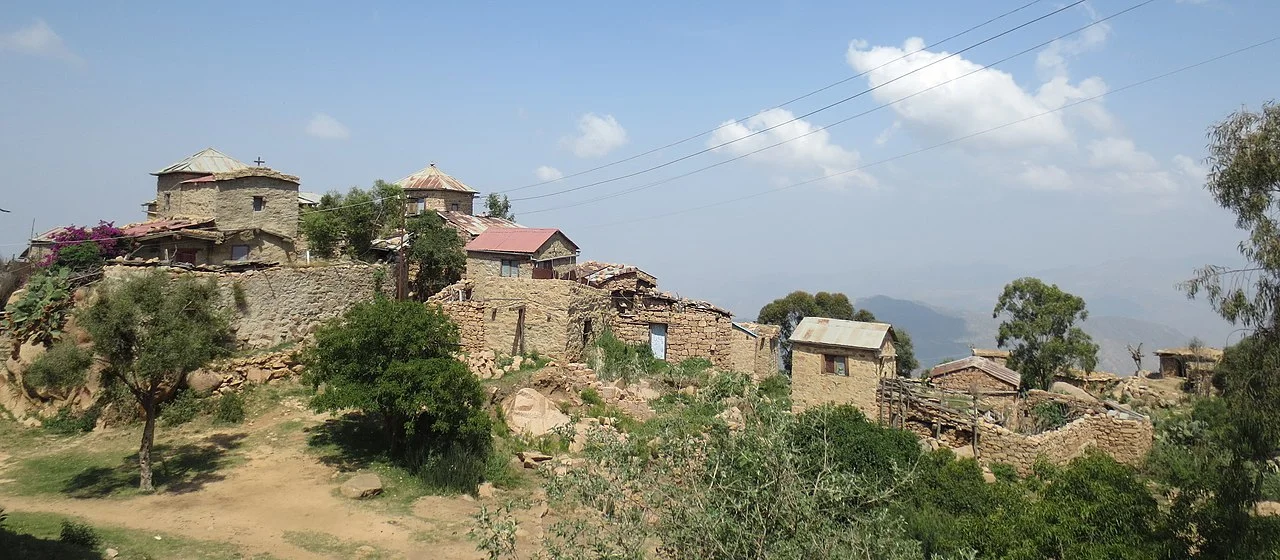
A blanket of clouds unrolls every day off the Red Sea at the 4,000-foot level, so af­ ter climbing the escarpment's sun­-drenched westerly face we arrive at the mile-and-a-half-high monastery's east­ern gate just in time to see the earth dis­ appear below our feet. Welcome to heaven.

A noisy troop of hamadryas baboons block the path as it levels into a clearing where the unwalled church and dormito­ries are grouped. Today the baboons are well fed and do not challenge us. We have been warned in Asmara to drop every­thing and run for our lives if they do.

As we enter this skytop village, its honey-colored masonry glows in super­natural light. From one building we hear the tired polyphonic chant of an all­ night prayer vigil. We continue on to a courtyard and the open door beyond. Samuel calls out for Brother Tesfamarian. "Enter in peace my sons," comes a husky reply from a candle-lit room.

The good Brother is a grey-bearded an­ cient with a twinkle in his eye. "Fifty­ seven years," he says. "Fifty-seven years without once going down." I can see why his eyes might shine at the sight of visi­ tors. The monks take year-long turns re­ceiving guests, and lately, with the coming of independence and peace to Eritrea, more tourists have been making the climb. And bringing wine .

Samuel speaks Tigrinya, the colloquial tongue of the Eritrean highlands, while Brother Tefsamarian answers in Geez, the Coptic liturgical language which com­ pares to everyday speech as Latin does to Italian. Understanding does not come easy. "Yes, yes," says Samuel, finally com­prehending the question. "Let us break our fast now if you wish."

·  We are invited to eat from a plate of day-old injera, a pancake made from a sourdough of the Ethiopian  grain called tef From a clay jug we drink an overly yeasty honey wine . Now I get it. We have to take Brother Tesfamarian's  offering and he has to take ours. He uncorks and pours the Chianti like a true paisano.

Our bread and cheese are likewise ap­preciated. But our canned meat is a for­bidden food to these monks. Goat and lamb are fine, but they do not eat beef. Samuel apologizes while our host pours another glass. No harm done, he says in a language even I can understand.

A History Lesson

A Portuguese expedition chaplained by Francisco Alvares had landed nearby in the year 1520. Alvares's account men­tioned a monastery in the clouds as evi­ dence that Christianity thrived in the unknown land.

The men had come in search of the leg­endary Prester John , a Christian king thought to reign somewhere in Africa. Prester John was supposedly the author of a letter that had been circulating in Europe already for some 200 years, asking all believers to come quickly to help fight the infidels.

This desperately written plea was an impetus for the Age of Exploration in which Portuguese seafaring around Af­rica and on to Asia reached its greatest glory. And Alvares's landing on the Ethio­pian coast marked what might be consid­ered the beginning of Europe's colonization of Africa.

When Samuel translates my question to Brother Tefsmarian about the Portu­guese, his face lights up. "You are the first person ever to ask about them," he says. "It was a long time ago. Three of them died while they were here and are buried nearby. But tell me, do they still rule the seas?"

Samuel relays my rambling recap  of the last 500 years of European history as we stroll to the Portuguese sailors' crypt down a steep path. Inside, behind a large boulder, lay their remains. "I hear they were good Christian people," says the monk.

We climb back towards the church built by Tewodros II. Along the way we pass a set of arm and leg stocks for pun­ishing wayward monks. They are empty now, but I can't help wondering what sin could get a holy man into trouble so close to heaven. And then I remember the honey wine and Chianti.

Not everyone here is a tippler. Ancho­rites live on narrow ledges along the cliff face, subsisting only on acacia leaves. Brother Tefsamarian says, "God feeds them." With prodding he admits that at night the hermits are allowed to climb up to eat from slop buckets left at the refec­tory door. I roll the lingering taste of in­ jera over in my mouth and contemplate the dry crunch of an acacia sandwich. No thanks.

A 500-Year Old Library

It is now time for our good monk to open the books. I hope to see whatever I may of the library's highlights-the monastery's chronicle, illuminated copies of the Cop­tic Bible, the History of the Ethiopian Kings, and the gem of its shelves, the Lives of the Saints, a copy on vellum dating from 1361, the year of the Debre Bizen's founding.

The library is said even to contain a miracle. Buried deep in monastery rec­ords is the story of its own Brother Sil­wanus . While washing clothes one day in the dusty courtyard, he glanced up to see Jesus extending his foot. He washed the foot, Jesus disappeared, and since then a patch of green grass has grown on that otherwise bare spot without ever having been watered.

As we enter the darkened room, no larger than a monk's cell, a prayer crosses Brother Tefsamarian's lips. He walks to a waist-high bookstand where an oversize tome lies open, closes it quickly, and kisses its well-worn leather cover. Books are heaped haphazardly on the shelf and three reading tables.

Samuel translates for me, "It is an honor and a blessing to enter this room. Please Brother, let us read from its pages." A sudden frown creases his face.

"For you to open our books is not per­mitted," he says. "Only those who have been ordained here are allowed. And that takes 30 years of study."

No amount of begging can change the verdict. The monastery's books must re­ main closed to outsiders. My final plea to the abbot for special permission to see the books is shrugged off. Brother Tefsa­marian ushers us out, locks the door, and abruptly takes his leave. Our eyes blink dumbly in the light.

As we drop below the cloud bank the light becomes diffused. Now and then through a break in the cover the sun spot­lights distant points of land. On one occasion a slanted beam trains on a far-off field of green tef, making it sparkle as if it were a faceted emerald. Samuel taps my shoulder. "Look there," he says. "God's paintbrush. More beautiful than all the books we could not see."

I say that I agree. But still I wonder if an­other bottle of Chianti might have done the trick with Brother Tefsamarian.

1280px-Debre_Bizen.jpg

101 Objects from the Lands of Islam- How to Count, Cook, Calligraph and More, From Morocco to Indonesia, #101

TO THE END

-THE ARABIC NUMERAL 1··1, OUR 1001, THE MOST WIDELY RECOGNIZED NUMBER OF THE MIDDLE EAST- JUST ASK SCHEHERAZADE ….EACH NUMERAL CONSISTING OF TWO DIGITS OF WAHID (ONE), A SINGLE VERTICLE STROKE LIKE ALIF, AND TWO DIGITS OF SIFR (ZERO), A DOT ON THE LINE’S MIDDLE REGISTER, NOT A CIRCLE DRAWN TO THE TOP (AS IN THE WESTERN ZERO- INSTEAD THAT IS AN ARABIC NUMERAL 5!), AND NOT A POINT ON THE LINE’S BOTTOM REGISTER (THAT IS A PERIOD, BOTH IN ARABIC AND ENGLISH SIGNIFYING THE END).


101 Objects from the Lands of Islam- How to Count, Cook, Calligraph and More, From Morocco to Indonesia, #96-#100

LIGHTING

-BRASS CANDLESTICK, often with inlaid silver calligraphic verses, zodiac, and arabesque all-over design, which cast an eerie glow when illuminated by a flickering flame in a midnight majlis

-13th-14th Century GLASS MOSQUE LAMP, MAMLUK era from Syria, WITH ENAMEL INSCRIPTION- USUALLY Sura 24,Verse 35- “HE IS THE LIGHT OF THE HEAVENS AND THE EARTH”…COPIED frequently and with perfection IN 19TH Century FRANCE when orientalism was in fashion

-CERAMIC OIL LAMP, ALGERIAN BERBER TRIBAL areas inland and upmountain from where coastal Roman era olive presses once provided edible and fuel oils to both sides of the Mediterranean

-MANAR, a MODEL OF ALEXANDRIA Pharos, or LIGHTHOUSE, ALSO a COMMON NAME FOR GIRLS, NEWSPAPERS, AND SCHOOLS

-ALLAH in NEON LIGHT, FOR MOSQUES, especially in villages where electricity is limited, this what makes for their otherworldly green glow and the strange all night electrical buzz of transformers being overtaxed in the name of religion


candlestick.jpg
mosquelamp.jpg
berberceramiclamp.jpg
Lighthouse_-_Thiersch.png
NeonSignsInus-FreeShipping-10336-allah-neon-sign_991bb22e-39ca-4ecd-a4c1-89654da63c26__00895.1518184769.jpg

101 Objects from the Lands of Islam- How to Count, Cook, Calligraph and More, From Morocco to Indonesia, #90-#95

ARABIC PRINT and MANUSCRIPT PAGES OF KEY HISTORICAL TEXTS

-AL KHWARIZMI’S WORK ON ALGEBRA

-ILLUSTRATION OF SOCRATES, ILLUSTRATING THE ARAB TRANSMISSION OF GREEK LEARNING

-IBN KHALDOUN’S AL MUQADDIMAH, AS THE FIRST THEORY OF HISTORY

-TABULA ROGERIANA, created by geographer Muhammad al-Idrisi (1100-1165) for King Roger II of Sicily

-1001 NIGHTS, Alf Layla wa Layla, A new Edition in Arabic

-A Treatise on ASTRONOMY, SHOWING CELESTIAL MAPS


Al Khwarizmi’s Treatise on Algebra, manuscript page

Al Khwarizmi’s Treatise on Algebra, manuscript page

Socrates in conversation with pupils

Socrates in conversation with pupils

Ibn Khaldun’s Muqqadimah, manuscript page

Ibn Khaldun’s Muqqadimah, manuscript page

Al Idrisi’s Tabula Rogeriana

Al Idrisi’s Tabula Rogeriana

Alf Layla wa Layla, in six volumes

Alf Layla wa Layla, in six volumes

A bedouin camel constellation overlaid on the Greek constellation of Andromeda, from The Book of Fixed Stars by Persian astronomer Abd al-Rahman al-Sufi (903-986)

A bedouin camel constellation overlaid on the Greek constellation of Andromeda, from The Book of Fixed Stars by Persian astronomer Abd al-Rahman al-Sufi (903-986)

101 Objects from the Lands of Islam- How to Count, Cook, Calligraph and More, From Morocco to Indonesia, #84-#89

KITCHENS

-MAKHRATA, Egypt- The ROUNDED BLADE, DOUBLE HANDLE knife for cutting MULUKHIYA (an EGYPTIAN WEENING FOOD), LIKE THE ITALIAN MEZZALUNA HERB KNIFE AND THE INUIT ULU FOR SKINNING ANIMALS, IN EGYPT used to cut mulukhiya more finely TO INCREASE its MUCILAGINITY - THE SLIMIER THE SOUP, THE BETTER THE CHILD. NB the coincidence that the Egyptian colloquial word mukhaat, snot or mucus, is very close to makhrata, missing only a single consonant

-TAJINE POT, MOROCCO- on coals or in an oven, a covered clay pot for long slow stewing of lamb, couscous, nuts, dried fruit, etc

-TANDOOR OVEN, INDIA and PAKISTAN- its etymology from the Akkadian word tinûru- “tin” meaning mud, “nuro” meaning fire- a cylindrical clay jar shaped oven for baking bread slapped onto its sides, roasting skewered meats angled inside, and heating pans of stews, vegetables, etc set on its bottom

-Kukusan, Indonesia- a woven, split bamboo conical mold for shaping cooked rice, to make Nisa Tumpeng, a main dish of the Selametan (many variant spellings, from the Arabic root salama) - a communal meal of thanksgiving that according to Indonesian Islam expert Clifford Geertz is central to the Javanese religious system, “a simple, formal, undramatic, almost furtive little ritual”

-LOCKING HANDLE, DOUBLE SIDED MASGOUF GRILL, IRAQ- Like the exoskeleton of a monstruous Euphrates River Masgouf (a shabout variety of carp, weighing up to 50kg and reaching 2m- as Pinocchio would have seen trapped inside Monstro himself), this squeeze grill wrought by Iraqi ironsmiths makes possible the all day banquets at Baghdad’s fish restaurants, at least until the fatwa is read that forbade the human consumption of shabout flesh, because the shabout had been consuming the flesh of humans dumped into the river.

-STREAM-SIDE, PADDLE WHEEL-POWERED ROTISSERIE, Bosnia- fire from logs cut in the Dinaric Alps and rushing water from the Neretva River upstream from the Mostar Bridge combine to roast lamb quarters

https://commons.wikimedia.org/wiki/File:Molokheya_Makhrata.jpg
Md.Boualam_Tajine,Outdoor_cooking(1).jpg
p10.jpg
kukusan.jpg
selamatan.jpg
masgouf.jpg