Rid of the Person, Escape to the Poetry

And so it was Shahid entered the broken world/when everyone had bypassed the heart’s expectant bones

-Bones (After Hart Crane), Ghazal by Agha Shahid Ali

Don’t ask what happened to the defeated heart/Oh Faiz how it broke once again/into hopeless longing.

-Ghazal by Faiz Ahmed Faiz, Translated by Agha Shahid Ali

These problems of mysticism! This discourse of yours, Ghalib!/ We would consider you a saint-- if you weren't a wine-drinker.

- Ghazal by Ghalib, translated by Frances Pritchett

Tell your friends, Dagh, it’s not child’s play. The task of learning Urdu is uphill all the way.

- Ghazal by Dagh Dehlvi

I was at a mushaira, a gathering of Urdu poets in recital, one night in Karachi and I wandered backstage where I found 12 year old Anum Masood and her pink autograph book filled with bits and pieces of ghazal couplets she was jotting down from her favorite poets. She also wanted them to write their pen names, their takhallus, which all poets use in their ghazals’ last verse, as both a reflexive tribute to their implied genius and as a cry from the heart. Most ghazals can make the audience cry, or cry out Vah! Vah! and wave their hands in the poet’s direction, as if to tell them, I hear you, superb.

Takhallus is a word of Arabic origin meaning escape, liberation, or flight from- or riddance- as if the poet must establish a second persona, one not of himself, in order to compose and recite in public. Even when the takhallus is simply the poet’s first name, it is still an escape of sorts from whom they were born as. So I wondered whose names Anum was collecting in her pink book, and if she would remember them when she grew up.

9518_116.JPG
9518_099.JPG

Smite the rock, pour the water, toss the filter

And remember when Moses prayed for water for his people and We replied, “Strike the rock with thy staff” whereupon twelve springs gushed forth from it, so that all the people knew whence to drink. And Moses said, “Eat and drink the sustenance provided by God, and do not act wickedly on earth by spreading corruption.”

-Sura 2, Verse 60, Quran

Behold, I will stand before thee there upon the rock in Horeb; and thou shalt smite the rock, and there shall come water out of it, that the people may drink. And Moses did so in the sight of the elders of Israel.

-Chapter 17, Verse 6, Book of Exodus

We were worried about having to drink dirty water from open wells so David brought a carbon filter water pump from an outdoor gear store in the USA. We gave it a try on the first day on the trail when we poured water from freshly tanned goatskins into a bowl and it came out colored brown looking like strong tea, with wafting goat odor and floating hair. Dave pumped it into another bowl and it came out crystal clear and smelling sweet. Wallahi al Azeem, By Allah the Great, they said.

The pumping got harder gradually and then the pump froze up in its casing. We changed the filter, we had one extra, which was almost black from all the skin tanning it had cleared but the pump was still froze. Ma yinfaash, they said, It’s worthless.

So we threw it away on that first day and drank goat tasting and smelling water from the skins until they finally cleared up on their own. And we shared everyone else’s germs, their coughs and sniffles, until we’d passed them all around. I doubt the filter would have helped us avoid the common Sudanese cold in any case.

three.jpg

Easy, Easier, Easiest

sahl easy②ashal easieral-ashal easiest④ishaal diarrhea

-Dictionary of Modern Written Arabic

We were approaching Wadi al-Kalabsha at night, not far from Aswan whose glowing lights we could see. We were low on water, dead out in fact, and tired, angry, and thirsty. Too far a ride for lake water, we’d have to draw from these putrid wells if we wanted to drink tea and boil millet. How putrid was it? We gagged on sulfur from a distance.

Government schemes had over fertilized the ground. Land reclamation in Egypt is a science of “more is more”- more irrigation, more nitrates, more urea. So the ground and its water smells as you might guess.

Before the lake rose and it was moved, Kalabsha’s wadi had been the site of ancient Nubia’s largest temple, a Roman era grand construction begun by Augustus and completed under Vespasian. One archaeologist called it “a common holy place for the Roman military and the nomads they were stationed there to control.”

Fast forward 2,000 years and, mutatis mutandis, I know for a fact that KhairAllah and Masood had nothing in common with Egyptian border guards stationed there to control them. Control? More like shake down. Not even worth going over to their post and asking for fresh water. So we drew from the well holding our noses and with it brewed rancid tea and boiled gaseous aseeda.

At midnight it all blew up, inside each of us one by one, getting up from our bedrolls, threading carefully but quickly through the maze of couched camels to the outer ring of light thrown off by our dying fire, and there in the sand dropping our drawers. Ishaal.

We thought it would be so easy, for sure easier than what we’d already been through, in fact the easiest part of the whole Way of the Forty, to finish this last bit of trail to Binban. But it was hard. And soft at the same time.

download.jpg

Passementerie Fit for a Bride

••••Marriage without the dowry is like an animal without a pack saddle••••He who says that a wedding is easy [to pay for] should only serve water••••Marry a short one, when you cut clothes for her it won’t be a problem••••She is like a needle that sews clothes for others but is herself naked••••

-Wit and Wisdom in Morocco (1930), proverbs collected by Edward Westermarck

We were told to get in touch with Amal when we arrived in Fez. She would take David to the shops and artisans in the medina where he would take photographs for the magazine, to illustrate an article on the marriage regalia- wedding kaftans, head-coverings, pillow cases, bed throws- custom-ordered for a Fassi bride’s trousseau.

Amal was a teacher at the American Center and a very striking person- tall, clad in tight jeans, her hair honey-colored and uncovered, and in a hurry. She rushed us through the medina’s low-stepped and cobble-stoned streets swarming with shoppers, deliverymen, and pack mules.

••••Don’t marry a rich woman, she will treat you arrogantly and say, Fetch water••••The wife of a poor man is despised even though she dresses in silver and gold.••••Don’t marry an old woman even if you will eat with her pigeon and lamb••••Marry a woman of noble birth [even if poor] and sleep on a mat••••

Passementerie is a French word, for the passements sewn by 16th C. Parisian artists trained in a seven year apprenticeship to make the wardrobe for king and court, but today the word springs to life in the hands of Moroccan needle artisans, especially those in Fez. Threaded round buttons, tassels, fringes, borders, trimmings and edgings, galloons, rosettes, gimps, and pompons- these are the passements that beautify a Fassi bride.

Walking through the medina heading for the needle workers souk, Amal did not slow down. There were silk thread bobbins and folded satin base fabrics in all colors. Custom dyers unwound the bobbins and stretched out the hundred meters of thread to hang from overhead hooks along the souk’s winding passageways- as if guiding the rescue and return of a bride like Ariadne from her dark dungeon.

••••Don’t marry a tall woman, her clothes and underwear will embarrass you••••Not even a dog runs away from a house where there is a wedding••••The native of Fez when he swears is like a donkey when it feeds••••

Amal got us to where she had to go, not once losing herself in all the twists and culs-de-sac. But she must have heard an imprecation from the shadow- why was an uncovered woman running through the souk trailed by two Americans? From her mouth poured a volcanic retort of the foulest proverbs and most guttural curses to ever shame Westermarck in all his field research. She was hurried in both word and deed, and now all the world knew it. Fassi brides bow to no man.

colorful-moroccan-silk-thread-bobbins-450w-1133072627.jpg
colorful-silk-thread-in-the-store-fez-medina-morocco-EP6MJ4.jpg
tumblr_pe567dNWPo1tfpj0go5_500.jpg

Tangier, for the Interview

Dear Mr. Werner, I have not yet received your missive sent directly to Rue Campo de Amor, possibly because the authorities here have changed the names of all streets. None here including taxi drivers know the present names although they have been posted for three years. Whether I can be of any help to you I don’t know, but I shall be here all through January and should be pleased to see you. I have no telephone. Sincerely, Paul Bowles

-letter dated 28 Dec 1991

I had read his travel essays “The Rif, to Music” and “The Route to Tassemist” and did not believe him when he wrote that he had driven 25,000 miles during the last six months of 1959 while recording Moroccan music in all parts of the country. That is the circumference of the Earth, and the country is only 1,125 miles long and 325 miles wide. That would be like driving from Tangier to the oasis of Tah, on what was then the border with Spanish Sahara, back and forth twenty two times.

So I figured that the music must have been pretty good. I wanted to interview him about the music.

We stayed at the Grand Hotel Villa de France even though it was officially closed for a remodel, but the bell boy let us look through Room 35’s window, where Matisse had painted the view in blue over the winter 1911-1912. I had read Bowles’ essays in his collection “Their Heads are Green and Their Hands are Blue.”

I had been instructed to contact Bowles’ American secretary and Tangier neighbor Cherie in order to make the appointment to see him. I was told that no one could see him without going through her, that there had been too many hippie pilgrims just stopping by to say hello after the release of Bertolucci’s The Sheltering Sky. Cherie also had no phone, so David the photographer and I went to her apartment. She asked if we wanted to go upstairs one flight to see Bowles right that minute. We said sure.

Bowles’s door was open so we walked straight in. The front room had a fire lit in the fireplace tended by a Moroccan man with a hot poker busy turning over the burning logs. He was speaking loudly to no one in particular. Bowles was wearing a sweater and sitting on the sofa recovering from a flu and looking frail. Cherie introduced and left us.

I started by asking about his early field recordings, especially of the Berber ahidous and ahouache dances- what he described as “nights with fires and drums”- for the Library of Congress, the subject of my article. I told him I had read his lengthy correspondence with Harold Spivacke, head of the LOC’s music division who had made Bowles’ recordings possible. That warmed him up to me I felt. Most recent interviews had been only about the film. Too much hype he felt.

We talked about his multiple trips with the old reel to reel tape recorder, of how he had talked his way into many private ceremonies in rural and urban Morocco that included music- some religious, some social- in the years just after independence from France, when suspicions of Westerners were still rampant. Especially when they carried recording equipment never seen before.

We talked also about how Western music was infecting the non-West, and how non-Western music was infecting the West. He didn’t like it either way. He had first come to Tangier to study classical music composition with Aaron Copland, having his piano delivered to the house by donkey to work on his Sonata for Oboe and Clarinet. About his first days there, he wrote, “We landed and Morocco took over.”

Did he know then that the oboe is just like a Moroccan ghaita, with the same double reed sound, if played quite a bit wilder? He knew this very well in later years when he championed the Master Musicians of Jajouka. He must have smoked a lot of kif with them too.

There were several knocks on the door while I was there, all from hippie pilgrims hoping to shake his hand or get high. He no longer smoked, he said. Cherie steered the hippies out. David took him into the back room where the sunlight was streaming through the window for a photograph. We left, later wondering if he had recovered from the flu.

image-7.png
515ZKGRNF7L._SX304_BO1,204,203,200_.jpg

Leaving Marrakesh in a Big Hurry

“If he were going to run away he must go quickly.”

- The Spider’s House by Paul Bowles

I was going to Marrakesh with David the photographer to write about the Djemaa al-Fna. I didn’t know anybody there so I spoke with musician Richard Horowitz in New York to ask for some contacts. Richard had studied music in Marrakesh and knew a lot of people. He told me to look up [name forgotten, let’s call him Driss Bennani] at the Cafe de France. Richard said I could ask any of the waiters there, they all knew him, and once found to tell him that Richard said hi.

The Cafe de France overlooks the crazy day and night funfair that is the Djemaa al-Fna, its upstairs terrace full of European tourists and Moroccan touts, down-and-out street kids and swell-looking hangers-on. I told a waiter I was looking for Driss Bennani, just as Richard had said, and the waiter gave me a strange look. Marrakesh is full of strange looks so I wasn’t worried. He went over to talk to another waiter, they whispered and looked in my direction, frowned and then smiled, and then the first waiter came back and told me to wait.

A guy came to our table a few minutes later and introduced himself as Driss. I said I was Richard’s friend from New York and maybe he could help me get situated for my interviews. Driss asked about Richard, how well I knew him, and then said that he and Richard were really good friends and he had heard about me coming to town.

I usually don’t use translators or fixers or expediters- whenever I did, I found it best to go to the local university’s English Department and ask the teachers to recommend their best student. That seemed to work

I told Driss that I’d need to interview a cross section of the square’s performers, customers, vendors, and people just crossing through from one side to the other. A random sampling of its craziness- like snake charmers, child boxers, and fortune tellers- and its normality- like snail soup makers, orange juice squeezers, and second hand clothes sellers.

He said he would help, but first he’d like a beer. We hadn’t discussed what I would pay him for his services, we hadn’t even specified what they’d be. I thought I could interview in French and Arabic well enough without him, so I figured I’d pay for food and drink at the cafe whenever we sat together.

I didn’t want to start interviews right away, first I wanted to wander through the square alone, but he insisted on coming along, saying it might be dangerous for David with his camera. The Djemaa al-Fna is as crazy as they say. Crowds and hustles, passers-by and those deeply rooted in the same place year after year, trying to sell or buy, to pick someone’s pocket or to get picked up.

Driss turned out to have a big appetite for both food and drink. That was okay with me, I was on an expense account. He walked us to the hotel and sat in the lobby to talk. We were jet lagged and told him we’d see him at the cafe next day. The following morning he was again in the lobby. Maybe he hadn’t left.

It went on like this for three days. Waiting for us each morning, steering us to meet his “friends” in the square, drinking a lot of beer, then dropping us at the hotel. He became a sticky pest, increasingly meddlesome, intrusive, and overly familiar- somebody I might have said came straight from a Paul Bowles novel if I hadn’t met a few of his type already in my travels.

He never stuck his hand out but I knew that would come eventually. Dave and I did our work without taking his advice on who to interview or where to go in the square. Once when he brought over a street musician to the cafe, the musician said the interview would cost us twenty dollars. I said we’d buy him a coffee instead. He said he was losing twenty dollars in tips by leaving his spot, so he said no deal. I had never seen him playing in the square, and later when I went looking he was nowhere to be found.

I knew we would have it out with Driss sooner or later, definitely when we told him we were leaving town. I said we’d be leaving tomorrow, that he should come by early next morning for one final meeting, which I presume he took me to mean his payday. We waited at the reception for him to leave. We went upstairs to get our bags and check out. Our train to Tangier, to interview Paul Bowles, was leaving that night.

Back in New York I told Richard that his friend Driss was a real pain. Richard said, that doesn’t sound like Driss, what did he look like? I said, tall with glasses and long hair. Richard said, that wasn’t him, Driss is short and bald.

tourists-sit-on-rooftop-terrace-at-cafe-du-france-on-jamaa-el-fna-EMEENY.jpg
82943127-jamaa-el-fna-market-square-marrakesh-morocco-north-africa-jemaa-el-fnaa-djema-el-fna-or-djemaa-el-fn.jpg

Climbing Khephren at Dawn

“The sides are smooth and equall, the whole fabrick seeming very entire, free from any deformed ruptures or breaches.”

- Pyramidographia (1646) by the Englishman John Greaves, on the Pyramid of Khephren’s (Khafre) fully intact and polished limestone sheath based on his eyewitness account, proving that the sheath was removed between his 1639 visit and 1700, when it was described as being missing

“Back at the tent, skirting the base of the Pyramid of Khephren which seems to me inordinately huge and completely sheer; it’s like a cliff, like a thing of nature, a mountain- as though it had been created just as it is, and with something terrible about it, as if it were going to crush you.”

- Gustave Flaubert, diary entry from Cairo, Sunday 9 Dec 1849

In 1979 anyone could climb the Pyramid of Cheops. Dogs, monkeys, bears- just like climbing the Matterhorn. The Pyramid of Khephren was different- steeper by more than 1⁰, sitting on a higher bedrock base so that by trompe l’oeil it appeared taller, and topped by a forbidding overhang where the squared stones ended and the limestone sheath’s remains as smooth as slick rock began- what alpinists call a “death block” feature. That was the view of Cairo that I wanted, looking down on the Sphinx built by Khephren, son of Cheops, and over to the Nile.

Dave was game, so we set out before dawn by taxi knowing that it was better to avoid encountering the pyramids’ desultory guards altogether than to run into them and have to pay them off. No one deserved baksheesh just for permitting you to risk your neck.

I had already climbed Cheops so I knew the system. Block by block, each between 1.5 and 2 meters square, about two hundred of them in a kind of staircase- hoist oneself up to the next level and then hoist again. The same with Khephren.

I have forgotten its details but I doubt that I looked over my shoulder much on the way up anyway. The sun had risen and getting hot. And I was wondering about that overhang, where the easy steps ended and the slippery part began, only after you’d rounded yourself over the bulge and found toe and finger holds to help scoot up the last bit.

We sat down at that overhang and pondered a next move. We walked around it from underneath, lucky the blocks were mostly intact so we could walk on a level course of stones, and found a place where the overhang was less pronounced. I made a move up and over and found the smooth limestone sheath not to be as smooth as feared. It was an easy low crawl up the remaining few meters, belly flat, at 53⁰ of incline.

I remember the top being flat, the dimension of maybe two or three coffee tables, barely large enough for a group of two. We sat looking outwards, legs dangling, leaning back to the center and looking down at the Sphinx, which was the view I’d always wanted- straight down from Khephren, not at an angle as you see from Cheops. Cairo was already busy, loud, and smoggy. The Western Desert was hazy and just now waking up. We planned to go there next.

pyramid-khafre-stock-picture-1883699.jpg

My Ustadh in Winter

“Of those he has omitted, a considerable number are so grossly indelicate that he could not venture to lay them before the public, although it must be acknowledged that they excelled in wit.”

-from the preface to Arabic Proverbs, or the Manners and Customs of the Modern Egyptians, 1830, by John Lewis Burkhardt, explaining the omission of some proverbs from the original collection

“Al-musta’jil wa al-bat’i ‘and al-ma’diya yiltaqaa” “The hasty and the tardy meet at the Nile ferry”

- Proverb 52

My college Arabic teacher in 1974 was Ahmad Tahir Hassanein, a true ibn al-balad, or Son of the Village, as urban Egyptians would call a rural compatriot with rustic manners but honest customs.

I crossed paths with him once outside the library on a very cold morning minutes before opening hour, so we had to wait in the frigid wind. He was wearing only a light weight cotton jacket and a lumberjack type billed cap, the kind with ear muffs that can fold up and snap together on top with the chin strap. That day his muffs were pulled down and strapped under, making him look like an over grown Elmer Fudd.

He had once told our class the story of how, as a poor boy who had distinguished himself in school, he was given a scholarship to study in Cairo, which meant that he had to leave his village in the Nile Delta for the first time in his life and stay away for a year. Upon graduating, he made a telephone call to the village switchboard to say he would be coming home with his diploma on such a day at such a time. The elders where waiting for him in the central square- really more of a dirt-packed open space among the village’s crammed-together houses and market stalls.

My professor told us of how he stepped out of the taxi- he was a tall big man who had to bend over to fit into the seat- wearing a typical Egyptian government bureaucrat’s proud city clothes, a kam qusayr, or short sleeve safari suit, and carrying a Samsonite briefcase.

I had once entered a Cairo cinema for the matinee screening just behind a similarly garbed bureaucrat. We were asked to open bags for security. In his briefcase was a banana, a newspaper, and an alarm clock. I imagined that he was playing hooky that day from his job in Cairo’s massive government building. Reading the newspaper was his morning work, the banana was his afternoon snack, and the alarm clock was set to wake him from a siesta in time to leave the office early for the movies.

Professor Hassanein said that when he stepped out of the taxi, the elders approached not looking at his eyes but rather at his briefcase as if in awe, and then rubbed it like a city fetish, as a good luck charm symbolizing literacy and a government promise of a lifetime job. They all wanted the same for their children, whispering Subhan Allah, God is Perfect, said often when praising a perfect object.

In the wind and cold outside the library that day, the Professor tried to teach me an Egyptian proverb, patiently, with his lips shivering even after the doors had opened and we easily could have walked in and warmed up.

I have forgotten the Arabic but I will never forget the English translation-

A chance meeting is sweeter than meeting by plan.

This is true, he said, even if one is cold and under-dressed and- this he did not say- the other is a thick-headed student.

Qabḍ Jinsi and Cairo's Cinephile Shabaab

qabḍ (n.) contraction, constriction, constipation jinsi (adj.) generic, sexual, racial

- A Dictionary of Modern Written Arabic

Qabḍ jinsi- sexual repression, a phrase you learn pretty fast in a first year Arabic class taught in Cairo in 1979. The city of 8 million, reduced by age cohort, let us say adolescents and unmarried adults, half of them shabaab (n.) male youth, and half of them shaababaat (n.) female youth, but seemingly with only the boys on the streets, is still very full of repressed desire. Especially at the movies.

I remember going to the Italian Cultural Center in Zamalek for the afternoon screenings of uncensored new releases. One was Visconti’s last film L’Innocente with Giancarlo Giannini as a married aristocrat, Laura Antonelli as his wife, and Jennifer O’Neill as his demanding mistress.

The IMDB website has the following parental advisory…”Two scenes feature female frontal nudity--both also with a man--though in one the man is naked, the other he is clothed. In the first the couple is obviously making love--it lasts about 1-2 minutes. The second the man pulls a nightgown off the woman and feels her breasts. About the same length as the other scene.”

About midway through at the close of the second nude scene, very tame by my standards, all the young men got up to leave. I asked one of them, Why are you leaving"? He answered, khilis al-jins, the sex is finished. How do you know, I asked? He said, we only stay for the sex. We all saw it yesterday too.

I didn’t know what was more dangerous- a roomful of horny boys, or those same horny boys, still half cocked, out on the streets of Zamalek.

51wttkNzOLL._SY445_.jpg

Hyena Men

“The main trade here is in skins; the animals are worked all their lives then flayed afterwards.”

“You shouldn’t go thinking this place is completely savage. Everything’s really much the same as it is in Europe, except that here it’s another pack of dogs and bandits.”

- Letter from Rimbaud dated 15 Feb 1880 mailed from Harar

“We are at Harar, we are always leaving..we must find camels, organize the caravan…Quick, quick, they are waiting for us. We must pack up our bags and go.”

- Letter from Rimbaud’s sister dated 28 Oct 1891, describing his hallucination just before he died

I had always wanted to meet the Hyena Man of Harar. I had read that at night he played with them outside the city walls, that it had become a tourist attraction. And Harar was a city I had always wanted to see, not just because Rimbaud and Burton, Richard twenty five years before Arthur, had visited, and not only because Emperor Haile Selassie had been born outside the walls a year after Rimbaud had left town.

That Harar is called the fourth holiest city of Islam after Mecca, Medina, and Jerusalem always struck me as just more tourist talk- there is no official ranking, and Harar’s claim- that it had 365 mosques, a different one to pray in for each day of the year- is also not true, unless one counts prayer rooms that might double as coffee warehouses.

I was leading a group of American tourists and one Norwegian convert to Islam who wore a full black robe and hijab. One day when walking through the souk where eagles swoop down to take pieces of meat in their talons, the Norwegian began to feel faint. She was taken to the hospital where the doctors hooked her to a glucose drip whose bag and needle the tour company had to buy at the pharmacy. AIDS country, and sugar water can be expensive in the land of honey wine.

That night we went to the city walls, just beside the city tip, to see the Hyena Man. Other tourist groups had arrived, each vehicle arranged in a semi circle with headlamps on. A man came to center stage with a bag of meat morsels followed by shoulder-hunched and short-haunched hyenas. He fed them the way the Emperor, before being strangled to death in bed, was said to have had his lions fed, gently by hand, and then got down on all fours facing the crowd while the hyenas lined up beside him shoulder to shoulder.

The Hyena Man asked for volunteers to step forward if they would like to help him feed. I said yes, I got on my fours, the Hyena Man asked if I was strong, I said yes, so he prodded the hyena to step up on my shoulders with his front legs and stand tall. The Hyena Man made him reach up to his outstretched arm holding the meat up high over my head and take it gently in his teeth. I served as something of a throne, or maybe just a step stool. Who knew that hyenas were tool users. American tools.

hyena1.jpg
hyena2.jpg

Rimbaud carried weapons and coffee, we carried bras and panties

“…scorched, inhospitable terrain across the very northern tip of Somalia…Actually it is part of Somaliland…In physical reality it is a long way from anywhere…It was dangerous then and it was still dangerous when I visited the area. Literally to ‘lose’ your skin or your testicles was no longer very likely, but…”

- Somebody Else; Arthur Rimbaud in Africa 1880-1891 by Charles Nicholl, describing Rimbaud’s caravan route from the Somali port of Zeila up the Ethiopian highland to Harar

We were heading in the other direction, by land rover not by camel- down from Harar to Hargeisa, capital of Somaliland. An older gent from Texas and I had bought an ice chest of beer before leaving Harar, and we each had a bottle of scotch in there too. We knew we’d have to clear customs and switch vehicles at the Ethiopia-Somaliland border, but didn’t think much about it.

We should have remembered Somaliland’s strict prohibition on alcohol. But it was an easy thing to forget, especially after we had driven past the three story mansion rising up like a painted palace out of its scruffy mud hut and concrete block neighborhood in the town of Jijiga that belonged to Ethiopia’s biggest qat merchant, much of which he sold across the border. If they could chat and chew, I figured we could drink and drive.

A Somali porter carried our group’s gear across the no man’s land gap between the border posts and set it on inspection tables. O brother, this looked pretty official to me. Tafteesh kamil, as they say in Arabic- complete inspection.

Border guards in other parts of Africa love rummaging through tourist luggage, especially if they think it belongs to ladies and they might find, accidentally on purpose- with a “just doing my job, move along, nothing to see here” kind of excuse- a scanty top and bottom or two. But apparently not here.

Just as they were putting hands on the ice chest, I blurted out, Don’t touch that, it’s full of ladies’ underwear. Their grasping hands suddenly recoiled as if they’d heard a viper rattle its tail. The captain who spoke English asked a follow up question…”For how many women?” “A lot,” I answered, “for all the expat ladies in Hargeisa.” Knowing how much his country depended on international NGO income and expat development workers to keep the economy afloat, he waved the chest and all the rest straight through.

515ZKGRNF7L._SX304_BO1,204,203,200_.jpg

Our Dongolawi Greeting

“At this juncture, greeting parties from Dongola came out with gifts for the king and congratulated him on the ghaza [booty raid]. I realized now how stingy this Berberi king was, since he only gave five or ten sheep each from those countless flocks to the ulema notables…And he drank camel’s milk and ate millet bread in his tent. His food and drink were always mean and miserable. He was always drinking boza [millet beer]. I paid no attention however, and continued being sociable, humbly conforming to my surroundings in this place of exile.”

-from Evliya Çelebi’s Matchless Pearl, his map of Sudan and Book of Travels

We arrived at the Nile some 75 km south of town, watered our camels, all 150 of them, and walked over to a school at the invitation of teachers Abd al-Maula and al-Fadil, so we told their first graders that Jimmy Carter was a peanut farmer just like all their fathers were.

It was Day 21 on the Way of the Forty and I was ready for some R and R. Dave and I waved over a truck- “Are you going to Dongola? Without stopping?” “If God wills.” Good enough for me- and got aboard, which promptly broke down far short of where we wanted to get. We arrived long after dark when Dongola was deep asleep, so we paid for beds in the hotel’s common room and went out for dinner.

Not millet bread but whole wheat round loaves made over the night shift by flour-faced bakers from the Nuba Mountains who by oven-light looked like friendly ghosts. 15 piasters a loaf. Fresh bread is never mean and miserable, but I could have used some jelly. But no need for boza, they gave us tea in return for us telling them what had brought two Americans to Dongola at midnight. Whatever answer they may have expected, ours was way crazier.

Next day we had to get our exit stamps. Dongola’s military post doesn’t see many land crossers since Egypt is far away and most people leave by ferry through a different border check. The officer was amused, his three soldiers took turns approaching his desk having traded back and forth their sole army cap before saluting the sergeant and delivering the dusty registers, none of which was the right one. So he let us go without signature or stamp.

We had been told to wait for KhairAllah in al-Amiri Yasin’s market stall. Al-Amiri hadn’t been told we’d be coming, so it took a bit of explaining. The name of my friend Hajj Bashir abu Jaib, al-Amiri’s biggest client for his drover resupply business, then and still does open many doors in Sudan.

I remember watching al-Amiri and his fellow merchants weighing dates and rice and sugar by the kilo as they listened closely to KhairAllah and the other trail boss Muhammad al-Himri tell their tales of armed camel thieves and lost desert wells….and thinking, in Dongola they measure out their lives in tea spoons…on the Way of the Forty we drink water by the goatskin.

two-men-in-town-of-dongola-sudan-selling-and-making-tea-coffee-and-B9GDDJ.jpg

Macondo is much like Puerto Maldonado

Muchos años después, frente al pelotón de fusilamiento, el coronel Aureliano Buendía había de recordar aquella tarde remota en que su padre lo llevó a conocer el hielo.

-first sentence of Cien años de soledad

In 1973 it took me 3 days aboard a cargo truck on a dirt-quickly turning to-mud track to cross over the Andes and drop down the ceja de la selva past Quince Mil all the way to Puerto Maldonado on the banks of the Madre de Dios- called the Ruthless River by an adventuresome gringa who a year before I arrived floated a flimsy raft downstream from there and almost died. Nothing I did or even imagined doing was as dramatic as that.

I had read Peter Matthiessen’s The Cloud Forest about shooting the Pongo de Mainique on the fast-dropping Urubamba River, which runs north from Cuzco, not east. That was what got me to the Peruvian Amazon in the first place, but the Madre de Dios is tame, lazy, wide, and slow compared to the Urubamba- more my style.

Today on the map Puerto Maldonado looks like a city. Back then it was barely a town, more like a village. I remember buying warm bread in the town of Urcos as we started out from Cuzco, and was glad it was warm because I was so cold up at that elevation. Down in the jungle I dripped and panted, shed clothes and dried my face to no avail. It was too damn hot.

I remember sitting alone in the treeless Plaza de Armas on a concrete bench waiting for the next cargo truck to fill up with nuts and hardwood to reverse course up the Andes. I planned to be on it. Meanwhile I had a few days to kill on the plaza. No one else was out. No shade, high noon, too hot. As Ella said, But when the thermometer goes 'way up. And the weather is sizzling hot. It’s too darn hot.

Just me and the popsicle boy, maybe 7 years old, slowly making his square paseo at the plaza’s outer edge. When he got to my bench I waved him over and bought a chupete out of his styrofoam box. I don’t remember what flavor, it would not have mattered even if it had been my least favorite. I don’t have strong opinions about popsicle flavors anyway.

I ate it, he walked his round back to me, and I bought another, he solemnly making correct change. Our transaction was all above board. I ate another, he made another lap, I called him over again, and so on and so forth until I had bought and eaten all his chupetes. There must have been twenty five in the box, and he was as solemn and dignified making correct change for his last as he had been for his first.

I don’t think I could have survived my time in Puerto Maldonado without sucking that ice, sin chupar ese hielo.

But about that gringa. Just a year back I read her book, which tells how her raft got caught in a back water oxbow lake, and she and her husband could not push it out to the current, and they almost died, and finally were rescued by turtle hunters and taken to Riberalta, Bolivia where they were nursed off death’s door by an American Maryknoll nun.

I asked Sister Joan, a Maryknoll nun I knew who had been in Peru at the same time. She knew the nun stationed in Riberalta and remembered hearing the story. Crazy gringos, she said. And unlucky because they had no ice to suck.

Sailing to Dahlak

“As for myself, I boarded a Yemen boat…and reciting the Quranic verse, It will set sail in the name of God, and in the name of God it will cast anchor, and putting our trust in God, we set off for the island of Dahlak…A thousand Fatihas were being recited every step of the way so the boat was brim full of Fatihas. The truth is that without these Fatihas, that boat would not float safely on this sea for a single second…In short, we inched forward on the Red Sea in this fashion, threading our way night and day through coral reefs, full of anxiety as we carefully followed the shore for six days, calling at a number of islands to see the sights and passing by many others, until we came to Dahlak.”

- from Evliya Çelebi’s Matchless Pearl, his map of the Red Sea and his Book of Travels

I was in Massawa looking out to sea. I heard about a man with an 18 meter diesel sambuk and I had met a few foreign tourists ready for adventure. We teamed together to pay for the boat rental from Muhammad Ga'as, an Afar seaman who said he’d sailed these waters since boyhood. But Ga’as in his dotage didn’t trust himself to navigate the reefs, so we set sail under Captain Ahmad Din and a four-man crew, all claiming to know the way "from Suakin to Djibouti on this side, from Jizan to Aden on the other." We would soon see. None of the foreigners seemed to know the Fatiha.

The Dahlak Islands are bare, brutally hot, and pancake flat. The Umayyads established a penal colony there, but found no other use for them. Poet Abu al-Fath Nasr Allah al-Iskandari, quoted by Yaqut al-Rumi in his 13th-century Kitab al-Buldan, wrote, "The worst country is Dahlak, for whoever lands there, dies there." The saying "In dahkhalta jazirat Dahlak satansa ahlak"  may owe its survival more to rhyme than meaning, but it certainly sounds forbidding: "He who sets foot on Dahlak forgets his family."

Only a handful of the archipelago's islands are inhabited today, but the largest—Dahlak al-Kabir, or Big Dahlak—was the seat of an Islamic sultanate from the ninth to the 13th centuries. To visit from Massawa requires a five-hour passage across rough seas.

From Massawa's jetty we set a course first by nearby Dissei Island's rocky summit and the mitten-shaped Buri Peninsula's northern cape, and once in the open sea by compass point alone. Ahmad Din scanned the water for the Dahlaks’ mid-ocean shoals. This time all we saw were flying fish and dolphin—the latter called Abu Salamah, Father of Safe Delivery, who may or may not know the Fatiha .

Crosswinds pushed high swells that the sambuk mounted on the diagonal, waves washing over deck and draining down the center hatch. "Is the sea big today?" we asked Ahmad Din. "Big? No, today is small. Big is in the Bab al-Mandab, the size of a house.”

At last we entered a shallow lagoon on Dahlak al-Kabir's windward side, near the site of the long-vanished sultanate's seat of power. Its traces are gone but for underground cisterns carved from coral stone and a 2000-grave necropolis. A raggedly dressed guardian named Ali Mu'min, proud herdsman of the island's 50 live camels, also watched over the cemetery’s dead. Pointing to headstones of black basalt bearing mixed Kufic and cursive Arabic funerary calligraphy incised on their polished surface, I later found a translation for one of them…

Oh God, verily Abu 'Abd Allah Muhammad, son of 'Abd al-Rahman, son of Muhammad, is Thy servant and son of Thy two servants. Thou has taken him for Thyself and hast chosen for him what is near Thee. He lies prostrate in Thy presence and controls for himself nor harm, nor profit, nor signs rendering manifest his actions, waiting for the day of reckoning, announcing that he has put aside his faults, hoping in Thy mercy, expecting Thy forgiveness, seeking protection from Thy chastisement. Oh God, be compassionate of his prostration and make him forget his loneliness. He died, may God be pleased with him, on Wednesday, 23rd of Sha'ban of the year 327 [June 15, 939].

It was mid month of Ramadan and a Dahlakian named Yunis Hassan recalled the days not long past when pearling supplied the village’s full income. One weighing 10 grams once fetched him 10,000 French "riyals," so he said, but more often he went five days without any find at all. This day he was standing guard at the newlyweds’ door of his son and bride. We knocked and entered, Yunis knowing it to be good that honeymooners receive a group of blue moon foreign visitors. They might bear pearl, or lu’lu in Arabic.

Back on board above deck, the Captain declared the wind too high for a same day return passage. We would sleep and leave before dawn. A coiled bow line was my mattress and brown bilge water, or what would have fooled me if it were said to be not, provided a goodnight last sip. I woke with the sambuk already outside the lagoon. So what they had said was not true, for I had landed in the Dahlak and not died in the Dahlak. Al-hamdu li’llah, the first words of the Fatiha.
260px-Dahlak_reliefmap.png

Cousin Sissy in Cairo

“Take my camel, dear,” said my aunt Dot, as she climbed down from this animal on her return from High Mass.

- opening line of The Towers of Trebizond by Rose Macaulay

My cousin Sissy Schotten, married to a sporting guns dealer and former spy and prisoner of Israel, lived in Maadi, Cairo and spoke not a word of Arabic but looked like an Egyptian grande dame- black haired pulled back tight in a bun, dark eyed both in iris and upper lid, round faced and well powdered, and quite rotund.

She drove a compact car and when pulled over by the traffic police- no doubt fishing for rishwa- would flutter her tongue in a high pitched trill and drive off in a cloud of dust. No point in discussing a bribe without sharing a common language. Sisi means pony in Arabic, not milk cow.

I was in Cairo that year studying Arabic and I went to Sissy’s apartment once or twice as a way to be nice to a family cousin- don’t ask me how we were related- from St.Louis. Sometimes she took me to the Shooting Club overlooking the Nile for lunch, which I liked more than eating at her place.

I never saw her husband Ahmad Osman on those days but once I walked in to his gun shop in Giza to say hello. He knew who I was and greeted me fondly. I always wondered if the shop was a front for something else, and I was right to wonder, because later I read a book about Egypt’s espionage war against Israel, and how he was kidnapped by Mossad from Europe and put in a Tel Aviv prison until released in a spy swap. He was nicknamed “the Professor” because he taught other Arab prisoners how to read.

Sissy later told me the story of how they had met. She was in Seville with her mother and father to study flamenco guitar, her voice certainly deep enough to sing cante jondo. Ahmad was sitting at the next cafe table and asked her father’s permission to speak with her. Sissy had been long unmarried and was very agreeable. They spoke amiably and exchanged addresses. Ahmad then disappeared.

Months later letters started to arrive in St. Louis with European stamps. They were from Ahmad, he said he was not able to be specific about his whereabouts but asked that they become pen pals. They did, at first avidly, then quite loyally, and at last romantically. A year later, Ahmad came to St. Louis to ask for her hand and took her home to Cairo.

Sissy was the centerpiece of a social hub of American expats and visitors. She went to the Maadi Catholic church and knew the Khan al-Khalili tourist souk very well. At Christmas a year later when I was back from Cairo and she was in St.Louis to visit her aged mother, she left a present for me at my house. A brass door plate with my name etched in English, Arabic, and Egyptian Hieratic.

I did not stay in touch with Sissy. I heard later that Ahmad and she had moved to Budapest, so he could be closer to suppliers for his sporting gun business, which surely sounded suspicious to me. Maybe he was still a spy. And this was before the fall of Communism. My mother had her new address, and when another cousin visited Budapest one winter she looked her up and reported that she lived in an unheated Soviet era concrete apartment block far from the city center. I don’t know what happened to her after that, but I still have the brass name plate on my front door, and I think of her most times I see it, which is almost daily.

thumbnail_IMG_5610.jpg

Bonbibi and the Boy

Rai jabe bagh hoye ailo khaite dayar ma bonbibi ailo bonete” “When [Dakhin] Rai came as a tiger to eat me, Kind Mother Bonbibi came to the forest [to save me]”

-spoken by Dukhe, honey collecting boy

“I am Mother of all beings in the land of the eighteen tides. Anyone who calls me Mother is relieved of suffering. No injury comes to those in danger who call for me”

-spoken by Bonbibi, Goddess-Protectress of the Sundarbans

“Listen to my vow- I shall never harm he who appeals to You for protection”

- spoken by Dakhin Rai, Evil Tiger Demon, addressing Bonbibi

Verses from the 19th C. Bonbibi Jahuranama, narrative text read aloud by Hindu priests to mixed Hindu and Muslim devotees before altars with painted votive images of Dukhe, Dakhin Rai, Bonbibi, and others during Bonbibi Puja held every January in the Sundarbans

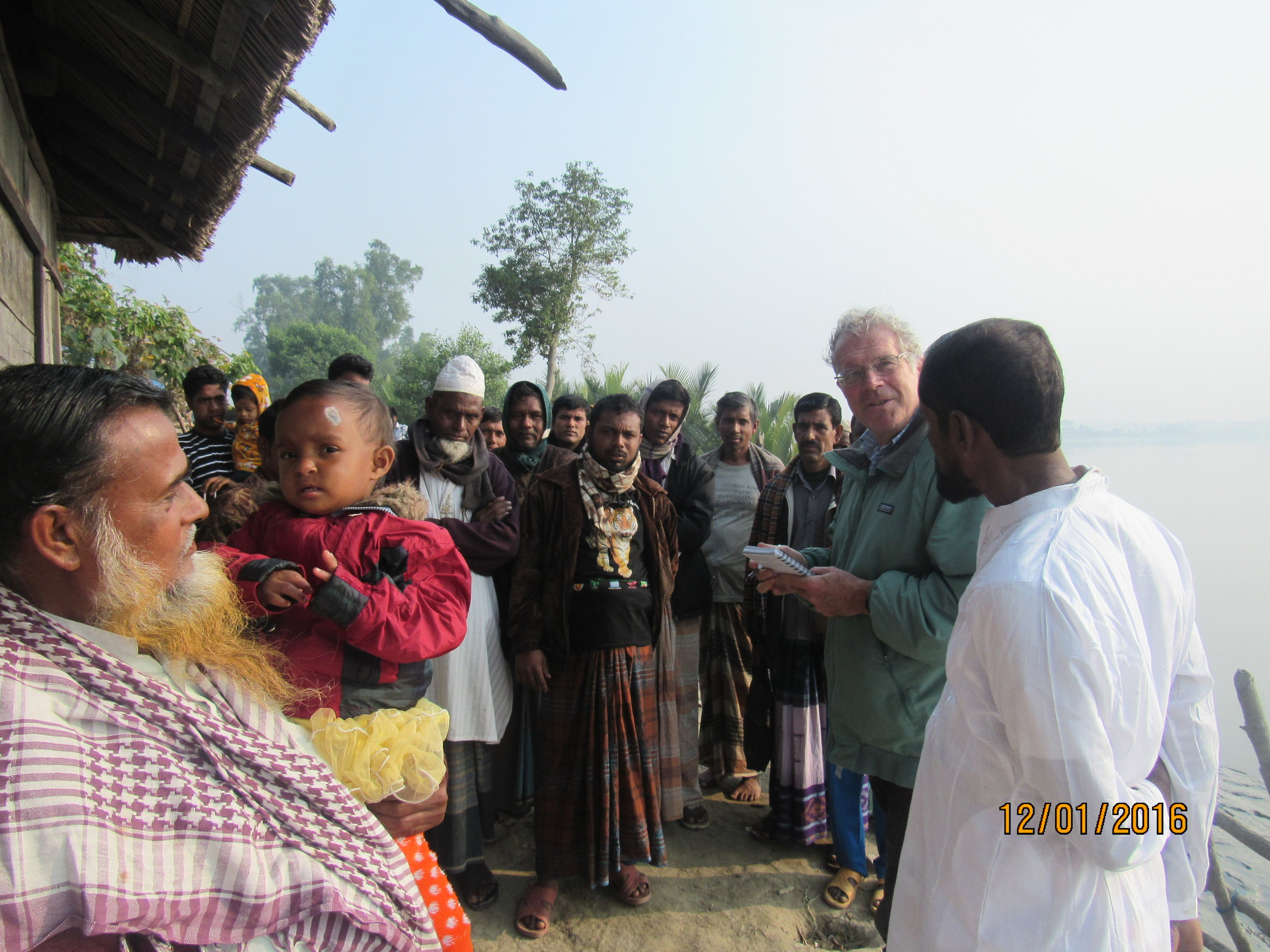
Still fearing the tiger that swims across the narrow tidal creek separating their goat pens from the forest preserve, the men of Kalabagi were not ready to rely on the protection of Bonbibi alone. To prove his point, village elder Abdul Bari showed off his leg scars where it had taken a paw swipe while climbing the tree after him. Abdul Bari’s neighbor and Tiger Response Team leader Farouk Hosein now had a gun.

Twelve year old Hridoy Mullah was not much older than Dukhe the boy honey collector who himself was almost eaten. In the story, Bonbibi heard his call and saved him. Hridoy was too busy banging his pot in fear for his life- a tiger was on the prowl in Kalabagi that night- to invoke Bonbibi’s name.

I was in the Bangladesh Sundarbans to write about the interplay of tide and forest, and man and environment, but tigers were still on my mind even though a recent count by bait station and camera trap had estimated only 100 of these large cats were on this side of the border.

The Bonbibi Jahuranama tells the syncretic Islamic-Hindu story of Bonbibi, daughter of Ibrahim and born in Mecca, who the angel Gabriel (Jibril) takes to the Sundarbans to protect forest workers from the Tiger Demon Dakhin Rai. The poor honey collector boy Dukhe is abandoned in the forest by a greedy merchant as his self-enriching sacrifice to Dakhin Rai. Dukhe’s timely prayer to Bonbibi saves him and all is forgiven at the end. Dukhe, now wealthy from honey and bees wax, marries the merchant’s daughter and Dakhin Rai accepts Bonbibi’s overlordship.

For the men of Kalabagi it is not so simple. Abdul Bari has seen thirteen tigers face to face in his life and never once Bonbibi. Has Hridoy Mullah even heard of Dukhe? No, he says, and he has never collected honey and bees wax in the forest. Both products are in short supply and heavily controlled through harvest permits. Does he know the name Bonbibi? Yes, he says. She lives in the forest and can make us rich if we pray to her.

Note the tiger on the black shirt of the man (standing center)

Note the tiger on the black shirt of the man (standing center)

images of Dakhin Rai (Tiger God), Dukhe (in blue shirt), and Forest Goddess Bonbibi

images of Dakhin Rai (Tiger God), Dukhe (in blue shirt), and Forest Goddess Bonbibi

at a Bonbibi Puja, Bangladesh Sundarbans, January 2016

at a Bonbibi Puja, Bangladesh Sundarbans, January 2016