Of Donkey Pads and Camel Saddles

O’Toole, having got a sore bottom from so much rding, when he had a few days off in civilization, purchased a layer of foam which thereafter he put under the saddle, whereupon the Bedouin called him Abu Isfanj (The Father of the Sponge); several of them took to following his example and this can be seen in the film.

-Camel, by Robert Irwin

Hajj Bashir thought that khawajas would need extra padding underneath so he ordered his agent Abdul Wahab to buy cotton pillows for our saddles. He thought that the Kabbashi way of building up their saddles, with folded blankets and waxed ground cloths, would be insufficient for his guests. The pillows were a good start but not up to the task, they quickly fell apart and David and I were soon riding on nothing but the wooden saddle frame. That hurt.

At the first opportunity, three days on when we passed Sodeiri’s souk, we each bought thickly upholstered leather donkey saddle pads tanned orange. We had to drape them over the saddle so they edged over off both sides, then rope them down with a second girth so they wouldn’t fall off.

We got a lot of guff and grief from the drovers for riding like donkeymen, as they called us, but we had the last laugh when after forty days of hard travelling we got to Binban and the Egyptian merchants, between their shouted offers to buy this camel or that one, having spurred their donkeys out to greet us at the desert fringe before others could approach and compete, offered us ungodly sums for the pads. They made their money buying Sudanese camels low and selling them dear, but the pads were more valuable than money. Soft seats prevented saddle sores, and that was cash in the bank.

KhairAllah and Talal of the Cubba-Beesh

The vicinity of the Bir al Malha is occasionally infested by the Cubba-Beesh, a wandering tribe, who, mounted on the swiftest dromedaries, rapidly traverses the desert, and live by plundering the defenseless. As they are, however, unfurnished with fire arms, so numerous a body as ours was not in much danger from their attack.

-Travels in Africa, Egypt, and Syria, from the year 1792 to 1798, William George Browne

I met Talal first because he lived in New York and I had read his book. I told him I was going to Dar al Kababish and asked him for pointers. He reminisced about the old days of his field research, living in UmBadr village in the late 1960s and feeling like the weekly supply lorry from El Obeid would never arrive. Later I heard from Mahdi that he had worked in the family shop in UmBadr and remembered “Talal the Khawaja” coming in often to buy jam and cheese and macaroni.

Talal wrote an ethnography on the Kababish with its focus on the political control exercised by their paramount shaikh, or nazir, who, in a rare case among pastoral tribes in western Sudan, had unusually close ties to the central government. The book included flow charts and organigrams of how the tribe’s lineages were structured and where high level decisions originated and through whom they were executed down below. I did not find much helpful advice on such topics of how to dress, when to go, and what I should expect to eat for breakfast, lunch, and dinner.

I met KhairAllah later, at the wells from where we were set to depart in a day or two. He was to be our khabir, and he was of the Kababish, the Arabic broken plural noun whose root gives the singular adjective, Kabbashi, meaning “of the Kababish”. I liked the tribe’s doubled consonant “b”. KhairAllah al-Kabbashi.

Contrary to Browne, KhairAllah did not plunder and did not ride the swiftest dromedary. He was a hired man in the employ of Mahdi’s father Hajj Bashir, who agreed against all common sense to let me and David ride with his camel herd to Egypt. KhairAllah was to be the herd’s leader and perhaps our babysitter.

As khabir, on the trail he had much power and authority, but consent he did not have in the matter of being stuck with two khawajas never before having ridden a camel. He worked for Hajj Bashir, and Hajj Bashir said that we were going with him. It was going to be a rough forty days for all three of us.

You must ask KhairAllah to be sure, but I would say that he had to baby sit David and me only once or twice, and that was in the first few days. After that, we both got the swing of things on the trail pretty fast. If an anthropologist had been along, he would have written an ethnography about inter-cultural joking and comic misperceptions, of why not to wear blue jeans in a camel saddle and how to fit five men around a four sided bowl of millet stew.

aaton.jpg

Arms and the Khabir

The Chabir, or leader, chose to notify his approach to the town by beating drums, (two of which he had borne before him as marks of his office, and as occasion might require, to collect the travellers when dispersed,) and by other tokens of joy, as firing small arms, shouting, &c.

-Travels in Africa, Egypt, and Syria, from the Year 1792 to 1798, William George Browne

Browne traveled the reverse of the Darb al-Arba’in, the Way of the Forty (Days), along its original inland route, from Egypt’s Kharga Oasis to Darfur and Kordofan. I rode in the opposite direction, from south to north, almost 200 years later and along a more Nile-sided route, but I found its sands and its gravels, its stones and flints, its petrified rocks and ostrich egg shell shards were no different than before.

Nor was the job of the khabir, the leader of the caravan, who chose which path of stones and rocks and sands to follow- in my case a man named KhairAllah KhairaSeed (spelled al-Sayyid), the Goodness of God, the Goodness of the Prophet.

Browne and his caravan were approaching Kharga Oasis, coming off the Asyut Plateau, when he described how its khabir notified the townspeople of his arrival by beating drums and firing small arms. KhairAllah when approaching a village with his herd of 150 camels would be much more discreet. He and his four drovers carried no drums or guns, only knives and, in one man’s saddle bag, a flute.

But out in the open desert, where thieves often lay by to cut out a camel or two from our night march, or where in broad daylight we might find ourselves approached by men unknown, most likely armed with Enfield rifles left over from WW2, but perhaps with automatic weapons- kalash, as they were called- spilled over from Libya, KhairAllah did indeed want to make a show of military force. That is when he asked Ned to shoulder his film camera as if it were a stinger missile and to get out in front of the herd for all to see.

This worked well for us in several ways. Ned always got good footage of approaching camel men. The camel men would greet us with genuine emotion- fear- on their faces, rather than the slack-jawed looks of curiosity that a foreign film crew in the desert usually elicited. And KhairAllah would get the jump on whoever might be approaching, friend or foe.

Lucky for us, they were always friends, and we all got good laughs when they finally figured out our weapon only shot 24 frames per second.

Aaton

Aaton

Stinger

Stinger

Of Dromedaries and Camels

The camel and the dromedary in Arabia are the same identical genus and creature, excepting that the dromedary is a high-bred camel and the camel is a low-bred dromedary…The dromedary is the race horse of his species, thin, elegant, light of step, easy of pace, and much more enduring of thirst than the woolly, thick built, heavy footed ungainly and jolting camel. But both and each of them have only one hump.

-A Year’s Journey through Central and Eastern Arabia 1862-63, William Palgrave

In 1984 I think I killed my dromedary. I had arrived at the half way mark, Day 20, on the Way of the Forty, and left the herd for a few days to take some rest in Dongola. I dismounted from my white dromedary, of the Kabbashi breed, of noble blood and as they all said, a great honor to ride. Nevertheless, he- as almost all camels exported to Egypt are bulls- was not easy to maneuver, I thought always needing a whip to steer through the bunch and past the thorn trees. Go lighter on the ‘oud, the stick, and gentler on the rasad, the rein, said KhairAllah, he knows what to do.

Maybe I had whipped too much over those twenty days. When I returned to the herd, I sought my familiar dromedary- to use a term of respect that now I know he deserved- but he was nowhere to be found. Huwa maat, said KhairAllah, he has died. Lucky for me, he did not say, Inta mawwithu, you killed him, but that is what he meant.

I could not believe that he had died, maybe in my absence KhairAllah had returned him to the herd, freed now of a foreigner’s burden, but I did not see him. There were not many all white camels to look among, and none had mine’s tell tale scars and tribal brands. No, he was gone.

KhairAllah gave me a new mount, this one brown and twice Ole Whitey’s size. He lumbered along in ungainly fashion but walked steady and straight. No fancy steps from him. I was happy all in all, even when thinking I had killed the most valuable asset in Abu Jaib’s export herd- if it had not been for one troubling thing.

Little by little I picked up on the drovers’ inside jokes and whispers and backward glances. The khawaja is riding a khasi, a gelding, they would say with a suppressed chuckle I might as well have been sitting in the corner with a dunce cap on my head, it was that obvious. Whenever we encountered others, all gave me the same smirk- thinking to themselves, You are riding a khasi, and that is bad enough, but even worse, that khasi is a camel, not a dromedary.

download.jpg

Visiting Friends in Omdurman

The native town of Omdurman which was the capital under the Mahdi regime…with room for upwards of 100,000…became the scene of the most atrocious cruelties and the most extravagant orgies…

The warlike oppression before 1899, the fanatical enthusiasm for pilgrimages, the desire for plunder, and the devastation of whole provinces have assembled here a confused medley of the most diverse races and stocks…[and] tribes from the desert, such as Nuba, Baggara, Kabbabish, Gowameh, and Kowahleh Arabs...

-Baedeker’s Guide to Egypt and The Sudan, Seventh Edition, 1914

Karl Baedeker and his son Ernst were the Frommer and Fodor of the 19th Century, but Ernst died of sunstroke in Egypt in 1863 in the month of July, which if he had followed his own advice would not have happened because one should never go in high summer.

Their 1914 edition covers the Sudan just 15 years after it was retaken by Lord Kitchener in the Battle of Omdurman, killing 10,000 Sudanese against a handful of Britishers, as narrated in the cold-blooded derring-do voice of Winston Churchill’s The River War- “Talk of fun! Where will you beat this?”

By then safely subdued, Baedeker described Omdurman as a tamed beast. His fold-out map identifies the city’s British-made ruins- “Arab Quarter Ruins”, “Khalifa’s Body Guard Quarters Ruins”, “Ruins of Taishi’s Quarter”, etc.- right beside the new “Polo Ground” and “Golf Links”- as if Baghdad’s Oz-like Green Zone was adjacent to Bush’s shocked and awed busted bunkers, never having been rebuilt.

But fast forward seven decades to 1984 and years following to my own visits to Omdurman, to sit in the office of my camel merchant family friends located where golf and polo were once played, in a city grown twenty if not fifty times larger than Baedeker said it had room for.

Despite Baedeker’s recommendation to tour Omdurman by donkey and not by tram, I took a taxi from Khartoum across the old White Nile bridge, then along the river’s west bank past the Mahdi’s tomb and into the rabbit warren streets of the city proper. On each new visit I forgot the route and each time the taxi driver and I had to navigate by dumb luck. But we always managed to find the ‘Imaarat Abu Jaib, the Abu Jaib Building, where I might have to wait downstairs if Sayyid had not yet arrived with keys to open the office.

When he was late, Khairallah would be sitting with Sakeena, the jebena coffee-making lady whose stall and low seats were near the front door. We all laughed about Sakeena, maybe because the word “sakeen” means knife, and Sakeena’s tongue was sharp. She knew me by name which was satisfying, and she knew KhairAllah as my friend from the camel road to Egypt, which was even more so. In the streets of Omdurman, “desert cred” got one far, since most people there were from the western provinces and knew the way of the sand.

I took my coffee unsweetened, which made Sakeena joke that I must have a very sweet girl at home not to need any sugar here. KhairAllah and I told her stories from the desert, about camel thieves and bedbugs and such, before Sayyid would pull up in his chauffer-driven blue Mercedes diesel sedan, and then we would go upstairs to the majlis to talk more about camels, leaving Sakeena on the street to make coffee for people wearing shirts and trousers, not ‘araagis and sirwals as her tribal compatriot KhairAllah wore.

download.jpg

My Cairo Coffeehouse as Home Away from Home

“The multitudinous Arab cafes are small and dirty and hardly worth visiting. Coffee in the Arabian style can easily be obtained elsewhere.”

-Baedeker’s Guide to Egypt, 1914

Today I was trying to find my favorite coffeehouse in Bab al Louk, whose name I’ve forgotten, using Google Earth or Google Maps but had no luck. I know it was beyond the Houriya bar, where back then and still today you can have either a Stella or a qahwa, but the place I’m remembering was closer to Abdin Palace on a little traffic circle. Where I think it was is now shown as a butcher shop. A lot can change in forty years.

Coffeehouses in Cairo were a safe haven for male American students of Arabic but not for women, who knew they would be breaking so many taboos if they sat down that they did not think it worthwhile no matter how tired or caffeine deprived they were. So men in Cairo never get as tired or unjumpy as women, because they can sit down anywhere. Coffee houses are all over town.

You order Turkish coffee with the sugar already boiled in- so you have to specify if you want qahwa saada, qahwa mazbout, or qahwa ziyaada- that is, “unsweetened” [black], “controlled”, or “extra”. The past participle mazbout comes from a verbal root meaning “regulation” that also generates a word meaning “police officer”. I liked to think that the sugar in my regular coffee had been “policed”, by who I didn’t know, maybe the mukhabarat, the secret police. And the verbal root of the word ziyaada, meaning “increase”, also generates the word tazayyud which means “fable” or “yarn”, as if drinking extra sweet coffee will make you into a liar. So Cairo is full of kazzaabs. I thought so.

74d18aa875bea2c77bda90d5ee10d508.jpg

Lemonade from a Goat

“If they want to ride lemons, let them drink lemonade”

-with apologies to Marie Antoinette

The amount of water a camel needs varies according to the conditions…When thirsty, they can drink 80-100 liters of water at a time.

-A Field Manual of Camel Diseases, Ilse Kohler-Rollefson, Paul Mundy, and Evelyn Mathias

It had been a long first day in the saddle. Glad finally to be on the trail, we all overdid the hooting and the hollering, the kicking and the whipping. We three foreigners were bone tired and parch-mouthed, Steve especially. Our camels were not the fastest mounts in Hajj Bashir’s herd.

KhairAllah said he would make lemonade, since the lemons were fresh now and would not last, and on this first day there was plenty of sugar to waste, a word the drovers had used, on a drink that was not their beloved tea.

The water poured from the skins was black and smelt like goat, but to KhairAllah that was nothing. When boiled, the smell lessened, and when brewed, the black tanning blended to almost normal looking tea color. But we were drinking the water fresh, not boiled, so the smell and the color remained. Lemonade the color of squid ink, with floating goat hair.

KhairAllah handed Steve the bowl first, the same bowl we would use over the next forty days for washing hands, soaking rawhide, and measuring out sorghum to feed the two yearlings. He took just one look and passed it to his left. No, I don’t drink lemonade that looks like that, he must have thought. You have some, he said. So I did.

Kazzaabs and Mentirosos

“I make a living out of the fact that truth is stranger than fiction…Yet I venture to say that I have been called a liar more often than anybody in the world. Ordinarily when one is called a liar- well, to say the least, one feels hurt. But it is different with me. I do not mind it a bit. When I am called a liar by a reader, I feel flattered! That short and ugly word is like music to my ears.”

-from the Preface to Believe it or Not! by Robert L. Ripley

Kublai Khan does not necessarily believe everything Marco Polo says when he describes the cities visited in his expeditions…

-Invisible Cities, Italo Calvino

I always liked telling tall tales in foreign languages, partly because, as a leg-pulling American in the pre-Bush, pre-Trump days, I felt I was at an advantage and my interlocutor at a disadvantage even though it was his language and not mine. Now, not so sure this is true.

In 1984 in Sudanese Nubia I was sitting by lamp light in a mud dwelling and talking to farmers about New York skyscrapers. I said something that I knew to be true but I presumed they would hear, at best, as a truth stranger than fiction and at worst as a lie. I told them we had two 100 story buildings there, and waited for them to express disbelief. Kazzaab, I expected them to think.

Later I saw the film 11’09”01 September 11, 11 short films made by international directors responding to 9/11 in 11 minute segments. The short by Samira Makhmalbaf was about a teacher telling her young children in an Afghan refugee school in Iran about what had happened. She told them that a tower had fallen and asked if they knew what a tower was, pointing out the window to the brick kiln chimney. She asked for a minute of silence but, looking up at the tower, they didn’t know how long a minute lasted.

In Nubia, one old man told me he had heard about those buildings. And then he asked me if it was also true that they each had a grocery store on the 50th floor. He asked that with a smile, which I could not read either way. I hadn’t heard about that I replied, and I still could not say if he asked in all seriousness. The others did not seem surprised, as if to them it made perfect sense- where else would you buy gargeer and mulukhiyah, they must have thought, but in your own neighborhood.

On the 4th of July, 1973 in Peru I was asked how I’d like to celebrate my independence day. I said, in the traditional way, by boiling hot dogs in beer, then cooling the beer and drinking it. This is what we all did, I said. Tomas said, OK, let’s do it, that sounds good, so I then had to come clean with him. Just joking. And he said, I knew all along that couldn’t be true, because boiled beer is spoiled beer, and Americans are too practical to waste anything.

9780385403061-uk.jpg

St. Simeon Hoist on His Own Pillar

…Mebis, yesterday (it happened by chance)
I found myself under Simeon's pillar.
I slipped in among the Christians
praying and worshipping in silence there, 
revering him. Not being a Christian myself
I couldn't share their spiritual peace-
I trembled all over and suffered;
I shuddered, disturbed, completely caught up.
Please don't smile; for thirty-five years -think of it-
winter and summer, night and day, for thirty-five years
he's been living, suffering, on top of a pillar.
Before either of us was born (I'm twenty-nine,
you must be younger than me),
before we were born, just imagine it,
Simeon climbed up his pillar
and has stayed there ever since facing God.
I'm in no mood for work today- …

-Simeon by Constantine Cavafy

In October 2003 I was in Damascus on a Monday and I’d heard about Lukman Derky’s open mic poetry night, Bayt al-Qasid, at the Fardoos Hotel. I thought I’d go to read Constantine Cavafy’s poem about Simeon the Stylite. I had just been to see his wrecked basilica outside Aleppo in the so-called Dead Cities, ruined Byzantine era settlements large and small.

As often, Cavafy creates a fictional character of historical plausibility as the poem’s speaker, in this case a neo-platonic Hellene aesthete living in the 5th Century who interrupts an arid debate about who is the better poet, Libanius or Meleager, that he is having with his friend Mebis in order to recount a visit he had just made to Simeon’s pillar and his near-conversion experience there.

I thought, maybe there would be something in this poem for the young Syrian poets in the hotel’s basement bar. Any one of them could have been Mebis’ friend, the poem’s anonymous speaker, and they too may at one time or another have had a religious experience somewhere along the line.

I found Lukman in the corner smoking and talking to friends, I asked him if I could read Cavafy’s poem, and he said yes, but only if I could quickly find someone to translate simultaneously into Arabic. I would have to stop every few lines for the translator. That’s how I met Hala Feisal, a painter who said she would try. In a quiet corner I read her the poem, I explained its first person voice and how it should flow conversationally as if being spoken to a friend.

When my turn came I explained to the audience the situation of early Christianity in Syria, the poem’s moment in time, the gradual fall of Hellenism and the less gradual rise of Christianity, a slow motion paradigm shift of politics and belief. Hala did her best, the room was quiet, I think it followed and made sense.

This all happened barely six months after Bush invaded Iraq. There were many Iraqi refugees already in Damascus. I remember talking to some in a restaurant. They were glad to be out of there. I don’t know if any Iraqis were at the Fardoos that night. In any case, for them the paradigm shift in politics and belief was not gradual, but fast. But as did Mebis and his friend in Cavafy’s poem, they did not go back to discussing poetry after an improbable diversion to the foot of Simeon’s pillar. Then, there would have been nothing left, a bit like that rough stone that now sits on the pillar’s pedestal.

Kevin Bubriski’s superb b/w photographs of the Basilica of Saint Simeon are in Legacy in Stone: Syria before War, Powerhouse Books, 2018

open mic poetry night in Damascus, before the war

open mic poetry night in Damascus, before the war

a stone marks the site of Simeon’s pillar

a stone marks the site of Simeon’s pillar

A Cure for Serpents- Being Robuste

…“Or vedi com' io mi dilacco!/vedi come storpiato è Mäometto!/Dinanzi a me sen va piangendo Alì,/fesso nel volto dal mento al ciuffetto./ E tutti li altri che tu vedi qui,/seminator di scandalo e di scisma/fuor vivi, e però son fessi così”.

-Canto XXVIII

“Buaron, Rebecca, proprietress of Misurata brothel, 78-87; Ghazala, prostitute, 159-60; Gmera, prostitute, 88; Khadija, prostitute, 83,86; Mabrouka, prostitute, 87; Mahadia, prostitute, 83,85; Massauda, prostitute, 153-57; Mne, prostitute, 82,84,87; Prostitution, Moslem attitude to, 19; Salma, prostitute, 83; Yasmina, prostitute, 87…”

-Index to A Cure for Serpents, Alberto Denti Di Pirajno, memoir of an Italian colonial doctor in Libya and Eritrea, and later the Governor of Tripoli

If Dante placed a disemboweled Muhammad and a cloven Ali in the 8th Circle of Hell for fomenting schism among monotheists, the Duke of Pirajno would rather have lain there next to Gmera, Ghazala, or Mabrouka “The Lucky”.

Once in Libya I was being driven from Tripoli to Fezzan by two randy young men assigned to show me the country. We drove past a desert hospital in Mizda (according to the Duke, called by the Arabs the blad el asrar, the land of mysteries) and they wanted to pull over to see the “Ukraniyaat”, the “famously beautiful” (according to Libyan male folklore) Ukrainian nurses whose medical team was headed by the “voluptuous blonde” (in the words of a diplomatic cable from the US ambassador to Libya, released by Wikileaks) Galyna Kolotnytska, said to be Qaddafi’s mistress-cum-bodyguard.

I was told that I must read Pirajno’s memoir by a lady I’d met in Andes, New York, and was glad to have been given the tip, for after reading it I learned we had covered much the same territory- Mizda, Nalut, Ghadames, Massawa, Harar, etc. I remember once being told in Asmara at the breakfast table by a skinny Frenchman that because I was ”robuste” I had not gotten sick the night before, as had he and our other companions, from drinking bad alcohol at the hotel bar.

I did not need Dottore Denti’s well practiced medical knowledge of a body’s ills, chills, and other North African indispositions, which he cured most happily in Libyan brothels and Eritrean boudoirs and wrote about in the most exquisite detail, to know that being robuste is not enough for one to avoid a fever in Asmara or Tripoli. It also takes a bit of luck. Mabrouk!

1419276.jpg

A Night Out with Prince Muammar in Tawfiqiyya

For years, downtown's Al-Tewfikiya street was synonymous with the headquarters of the Muslim Brotherhood, until a government clampdown on the illegal group shut that head office down in 1995. Nine years down the road, some may find it somewhat ironic that the very same street would become associated with the launch of the largest-ever campaign against homosexuals in Egypt.

-Al Ahram Weekly, 4-10 March 2004

I forget the name of the seedy nightclub in Tawfiqiyya, just west of Ezbekiyeh Garden and north across Twenty Six of July Street. It was downstairs and its street door was unguarded. At the foot of the stairs we were asked where we’d like to sit, in which of the three concentric rings surrounding the stage- the innermost whiskey-by-the-bottle ring, the middle whiskey-by-the-glass ring, or the outer beer ring. Each ring had only one row of tables, so the sight lines were just fine for beer drinkers, so that’s where we sat and drank.

The MC was trying to warm up a sparse crowd, but only one table in the by-the-bottle ring was occupied, by an older gent in western clothes and a young man in dishdasha and flat fold turban, maybe Saudi, maybe Emirati-definitely “Arab”, as the Egyptians call them derisively. The gent kept the bottle closer to him than to the younger guy, but his glass was full too.

A belly dancer came on looking kinda lame. She only had that one table to dance for so she spent most of her time looking in their direction, showing us her rear end. No belly rolls for us. A dombek player and electric organist were already trailing off their trills and beats. The MC had to do something or he’d lose the crowd completely.

He grabbed the cordless mic and stepped forward. “Hayy al Amir Muammar. Hayy al Amir”. Long live Prince Muammar. Long live the prince. The gent followed his prompt and threw a bill onto the stage floor at the dancer’s feet. Another prompt, another thrown bill. Were they 1 guinea bills, or 5s? Either a buck and a half or seven? I couldn’t tell.

The MC kept at it, “Hayy al Amir, Hayy al Amir”, revving us up until we chimed in too. Finally Prince Muammar threw down a few of his own, enough for the MC to start his speech- evidently he had been waiting for this moment, and had it practiced- about how the Prince’s tutor was taking him on a world tour to learn about foreign lands and their customs, so he could go home as a wise man to one day run his father’s country- not quite the story of Candide and Pangloss, more like the Prodigal’s Return

We all applauded the story. The dancer came back, this time facing us so we could see her belly fat roll up and down. Not bad. Kind of mesmerizing. We left before Prince Muammar and his tutor. Maybe back in the hotel he got lucky with the belly dancer. More likely his tutor did, but on the Prince’s guinea, or was it a fiver?.

920x920.jpg

Drinking near Sugar Street

“He left the coffeehouse at nine thirty and proceeded slowly across al-Ataba to Muhammad Ali Street. Then, entering the Star Tavern, he greeted Khalo, who stood behind the bar in his traditional stance….The excessive reliance of these men on alcohol was apparent in their bleary gaze and in their complexions, which were either flushed or exceedingly pale… after imbibing the nastiest, cheapest, and most intoxicating drinks available….Khalo brought Yasin a drink and some lupine seeds. Accepting the drink, Yasin said, “See what January’s like this year!”

-Sugar Street by Naguib Mahfouz

“Cafes in the European style, at which beer and other beverages are obtained, abound in and around the Ezbekiyeh, none of them are suitable for ladies.”

-Baedeker’s Guide to Egypt, 1914

There were a few seedy bars left near Tawfiqiyya Square in 1979, not many but easy enough to find. I entered one after dark and took my seat against the wall. There were no chairs and tables in the center of the room, only pushed back against the wall, so you had to turn 90 degrees left or right to have a conversation, which is hard. Maybe they came here just to drink, not to talk.

Most were drinking zabeeb, (a clear alcohol made from raisins, which the word also means, and which by ironic coincidence is also the word for the forehead callus observant muslims develop from prayerful head prostrations), aka arak, raki, ouzo, fire water. And eating soaked lupine seeds- tarmus- from a saucer, and when the lettuce vendor made the rounds, nibbling on fresh green leaves like a rabbit might. Hydration. Good idea if you planned to drink all night.

I remember ordering one too many and stumbling home much later by way of the right bank of the Nile. It was not the most direct route but it is hard to get lost from there if you keep the Nile on your right hand and head upstream, turn sharp left at the British Embassy’s old walls, wind your way through Garden City, cross Qasr al-Aini, and take a few last steps up Tomb of Sa’d Street to my front door, unguarded so late by Ahmad the Bawaab, who I would not want to see in my present condition anyway. He might talk.

9780385403061-uk.jpg

A Film Screening in Umm Badr

“No leaders anywhere, in Brewster’s opinion, could have more physical presence than the nazirs and sheiks of the Sudan. Nearest to the High Table sat the king of the Meidob, and directly across from him was the nazir of the Kababish. Each was surrounded by several sheiks of his tribe. Across the aisle, they acknowledged one another with predaceous stares.”

-“Fifty-two People on a Continent”, an essay that begins with a portrait of an American working in Sudan, by John McPhee

McPhee describes a meeting between the heads of the Meidob and Kababish tribes near Umm Badr, where I went in 2010 to screen “Voice of the Whip”, a documentary film shot in places not far away. The film’s Arabic dialect is unique to the Kababish and nearly impossible for Arabs of other locales to understand- thus the fact that when screened before other Arabic speaking audiences, the film’s jokes and stories always fall flat and many can follow only with subtitles.

Thus Umm Badr provided “the perfect audience”, needing no extra-filmic explanations or translations, the kind of audience that documentary filmmakers are keen to have. In my case, it meant waiting twenty two years and travelling a hundred miles off the blacktop in North Kordofan province to reach them.

The village has no central electrical supply, only solar panels, batteries, and a community generator with long extension cords. We opted to run the DVD player and projector with solar, competing for power with a TV set up outside for an Africa Cup soccer match. We were indoors as night fell and started the film. Five minutes from the end we were shut down by an AK-47 toting soldier who insisted his commanding officer wanted to see me immediately.

We walked a few hundred yards in the dark to his post where the officer was also watching the match. I waited impatiently. The soldier offered me a broken plastic chair. I petulantly kicked it over and said, And you call this hospitality? You might have said that I gave him a predaceous stare.

The officer finally emerged from his TV room wearing a soccer jersey and flip flops. No, he said he had not sent for me, and he already knew that I was in Umm Badr with permission to show a movie. And no, he didn’t have time to come to the next screening.

I gave three more screenings that night, all powered by an extension cord from the generator because the solar panels had drained. It was a big success I thought, especially the last outdoor screening projected against a mud wall, on a hot night with no ambient light except for stars.

Many in the audience recognized the drovers and trail bosses on camera even though their faces were all twenty two years younger. They laughed at the lyrics of the camel driving songs- “O Rocket of the Sudan, your eye like a Seiko watch”- and one drover’s amorous address to a sand-roasted goat head- “You love me and my belly loves you”. No subtitles needed in Umm Badr. It was all in their language, spoken by familiar voices.

Capture.PNG

At the Movies with Ahmad

May Allah bless you. Praise Allah for your safe arrival. How is your condition? And yours? May Allah bless you. Praise Allah for your safe arrival. How is your condition? And yours? May Allah bless you….

-Straw boss Ahmad Hassan Abd al-Majid greeting Sudanese camel drovers upon their arrival at his Upper Egyptian stable, in a late scene in the documentary film “Voice of the Whip”, March 1988

I have known Ahmad since 1984 when I arrived for the first time in the company of Sudanese camel herders at his home in Binban Bahri village across the river from Daraw, 40 km north of Aswan. He was not expecting to find two Americans, me and David, in the company of the drovers after their completion of the camel trail up from Kordofan, but he threw down the welcome mat and received us like kings.

In following years I wrote him postcards from my foreign travels- India, France, Peru, Cuba- always addressing him with the honorific Al-Aakh al-Aziz, The Distinguished Brother, and adding formulaic words of greeting, knowing full well that it would be read by every Egyptian postman in its chain of delivery, from Cairo’s central PO all the way down to Binban’s humble mail desk. In those days the Egyptian postal service functioned well, and most of the cards arrived. He later showed me a stack of them.

In 1988 I needed another favor. Our film crew had decided to leave the herders on the Sudanese side of the border, fearing trouble with Egyptian police, and instead took the ferry to enter the country by the book. In Aswan the customs inspector bought our story that our 40 rolls of 16mm film, Aaton camera, and boom mic were just personal video equipment- the usual tourist stuff, we said.

We arrived at Binban a few days before the herd and told Ahmad that we would film the herd’s arrival as they approached. But we had problems. We did not know exactly when the herd would arrive, and our film camera’s 12 volt lithium battery had malfunctioned. We would need to improvise with 8 fresh D cell batteries strung together. Finding fresh batteries in rural Egypt is not easy.

Ahmad solved our battery problem, positioned us in the correct spot to intercept the herd outside the village, and had a vehicle stand by for us to film on the move when the time came. It all worked out perfectly, and we filmed Ahmad greeting the drovers and spreading straw bales for the hungry camels.

The film was completed in 1989 and I had returned to see Ahmad twice in the meantime but not with the film to show. The 16mm had not yet been transferred to DVD. In 2010 I had my chance to screen the film at the Nubia Museum and in Binban. I had my own DVD player and digital projector with external speakers.

We had three screenings- in Ahmad’s compound, one for the women and one for the men, and in the village diwan for the elders who had not come to Ahmad’s house. There was much murmuring of recognition and understanding from the audiences, because most knew the Binban merchants on camera, and they knew enough about the Way of the Forty to pay close attention to its daily details- making the millet paste dinner called aseeda, patching sore camel pads with cowhide, etc.

And naturally Ahmad was the village favorite- batal al-shaasha, I called him with a wink, hero of the screen. Greeting the drovers, giving them double cheek kisses and embraces, and acting like the camels were all his and his alone. It made him into a village big shot. A much bigger shot, no doubt, than someone who knew people in Peru, India, and Cuba who called him Distinguished Brother.

Capture.PNG

Recalling a Beirut Beach from the Banks of the Sudanese Nile

Beirut Welcomes Marines; Second Contingent Ashore; Beirut Receives US Marines from 6th Fleet Ships Quietly

Beirut Lebanon July 15 1958. Special to the New York Times. United States Marines landed in Beirut today at 3pm to back up the Lebanese government of Camille Chamoun against rebels or outsiders. The Beirut public received them like a circus coming to town..During the afternoon, formations of US jets shrieked over Beirut to the delight of small boys who shrieked back in excitement… Within five minutes the Marines were pouring across the beach flanked by crowds of admiring Lebanese…Difficulties arose because many Lebanese could not understand what the Marines said…

In February 1984 I was along the Nubian Reach of the Nile having dinner in the home of Hajj Hassan Sayyid in Farka Dal, near the Batan al Hagar, the Belly of Stone, where the Nile breaks through its granite shield to make one hell of a long cataract. It was just the local men folk and me and David, and one was the Hajj’s son Ahmad Hassan, who showed me his wooden leg and said it was a gift from America.

What did he mean, I asked. He told me that when the Marines came ashore in Beirut in 1958, he was a student sitting in a corniche cafe watching all the action. A gunfight broke out between rival Christian militias, in a sideshow to the international crisis involving Moscow and Washington, Communists and Capitalists. But the NY Times got it right, from the Lebanese perspective it was just a circus.

But Ahmad took a bullet that day and the doctors said they had to amputate. So he had to come home to Nubia where the electrical generators cut off at 9pm, hobbling from house to house, drinking tea and remembering the day the US Marines landed, and wishing he had not been there.

BEIRUT — For more than 150 news correspondents covering the Lebanese landings here, this has become the "taxicab war."Newsmen use taxicabs to race from one sudden and unexpected development to another. Military officials, on non-tactical errands, ta…

BEIRUT — For more than 150 news correspondents covering the Lebanese landings here, this has become the "taxicab war."

Newsmen use taxicabs to race from one sudden and unexpected development to another. Military officials, on non-tactical errands, take taxis to surmount the shortage of official vehicles, and diplomats, rushing from conference to crisis, hail a cab to keep their appointments.

The taxicab drivers are having a picnic and are among the very few in this "Paris of the Middle East" who do not miss the foreign money lost by the sudden decline in paying tourists.

image (1).jpg

The Spring of Ever Giving Life, in My Living Room

“You go west from St. Daniel, out of Constantinople, into the country where the monastery named Pege is. In this monastery there is holy water and holy fishes. The sick wash themselves with this water and drink it, and healing comes.”

- Russian Anonymous, a 14th C. Russian pilgrim to Constantinople

According to a late legend, the day of the conquest of Constantinople,  a monk was frying fishes in a pan near the spring. When a colleague announced to him the fall of the city, he replied that he would believe him only if the fishes in the pan came back to life. After his words they all jumped into the spring and began swimming.

-story recounted by Ernest Mamboury, Swiss scholar of Istanbul’s History

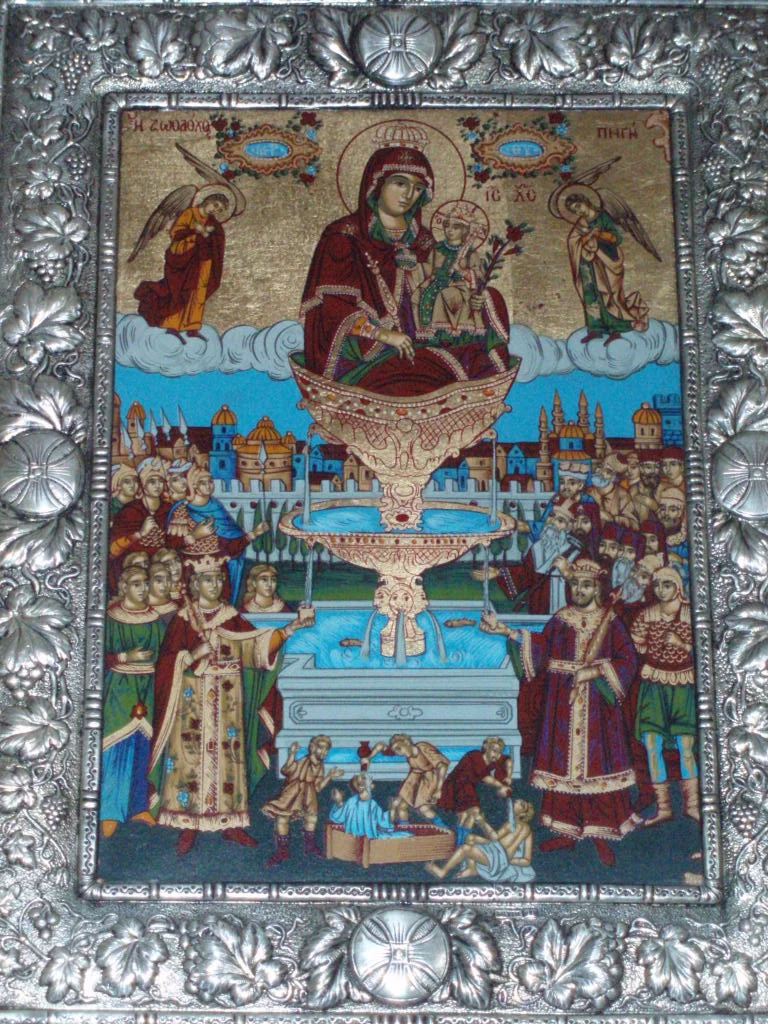
There was a Greek icon in my mother’s living room I knew nothing about until I saw the same image, the Virgin in the topmost basin of a multi-tiered fountain, in a book which identified it as the Spring of Ever Giving Life, the Zoodochos Pege, in Constantinople. The legend of the spring is associated, they say, with Artemis, the Greek goddess of the hunt, childbirth, and wild animals.

When I was in Istanbul I visited the spring, now with gold fish swimming, in the basement of a 19th C. Greek church, built on the site of an earlier church destroyed by the Ottomans. Its cemetery has headstones inscribed in Karamanli Turkish, Ottoman Turkish written in Greek letters, with objects depicting the trade of the deceased- wine barrels for tavern keepers, scissors for tailors, pens for scribes. You can buy vials of holy water from the spring but not fish.

800px-Church_of_St._Mary_of_the_Spring_9123.jpg
Panagia_Argokiliotissa1.jpg